I return the family headship to my older brother ~Mito Kōmon and Hatakeyama Mitsuyoshi~

Throughout history, there have been numerous disputes over the succession of family headship, but Mito Mitsukuni and Hatakeyama Mitsuyoshi were the ones who respected the order of seniority and returned the family headship from the younger brother to the older brother or the older brother's child.

It's been quite a while since Mito Komon ended its broadcast. It apparently started in 1969, making it a long-running program that lasted for over 40 years. Many Japanese people, especially fathers at the time, would watch it on TV while having a drink on Monday evenings, and felt a sense of satisfaction when the official seal was revealed. I think it's good to quietly enjoy the story of good triumphing over evil at the start of the week, but I'm sure I'm not the only one who hopes for a remake to be revived.

The Mito Domain was founded by Yorifusa, the 11th son of Ieyasu, the youngest of the three Tokugawa branches. Mitsukuni became the second lord of the domain, but he was the second son. He and his older brother Yorishige were six years apart in age and were both born to the same mother (Kyushōin). Their father, Yorifusa, ordered an abortion, so a retainer sheltered him in the Shigenoi family, a noble family, and he was later acknowledged as the son.

The reason behind ordering the abortion is believed to be that, while his older brothers (Tokugawa Yoshinao and Yorinobu), who ruled the Owari and Kii domains, had not yet produced an heir, Yorifusa felt it would not be appropriate for him, the youngest brother, to be the first to bear an heir. Six years later, when Mitsukuni was born, heirs had already been born in the Owari and Kii domains, but Yorifusa still ordered the abortion. According to Mitsukuni's memoirs, the reason seems to be that Kyushoin had not yet become an official concubine at the time, but he was raised by his retainers and came of age a few years later and became the heir. His older brother Yorishige became a daimyo of a small domain as a branch of the Mito domain, and eventually received the Takamatsu domain with a stipend of 120,000 koku.
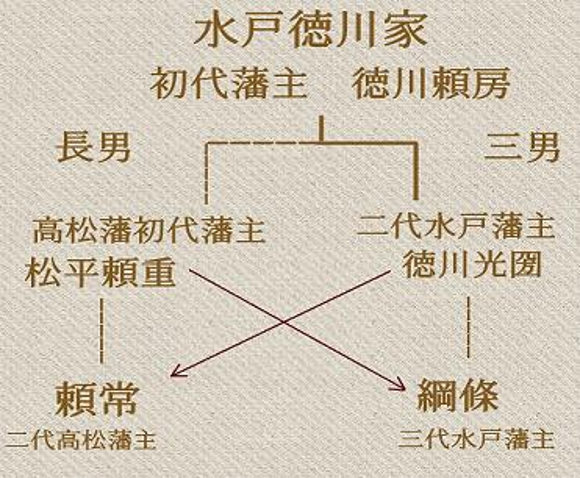
After succeeding to the throne, Mitsukuni gave his own son (Yoritsune) to be adopted by his older brother (Yorishige, lord of Takamatsu Domain), and took in his brother's own sons (Tsunakata and Tsunaeda) as his successor. In "Mito Komon," he visits Takamatsu several times, and there are lines in which he expresses concern for his own son, "Lord Yoritsune," which is one of the highlights for history buffs.
During the reign of Ashikaga Yoshimitsu, who reigned at the height of the Ashikaga shogunate, the Hatakeyama clan held high status, alongside the Shiba and Hosokawa clans, as they were appointed to the position of Kanrei (deputy shogun). Upon the death of Kanrei Hatakeyama Motokuni, his eldest son, Mitsuie, who had fallen from power due to Yoshimitsu's dislike, was unable to inherit the family headship, and his younger brother, Mitsunori, succeeded him. However, two years later, when Yoshimitsu died, he relinquished the family headship to his elder brother, Mitsuie, and in return, Mitsunori bestowed upon Mitsunori the position of Shugo (military governor) of Noto Province. This marked the beginning of the Noto Hatakeyama clan, a Sengoku daimyo family that was ultimately destroyed by Uesugi Kenshin.

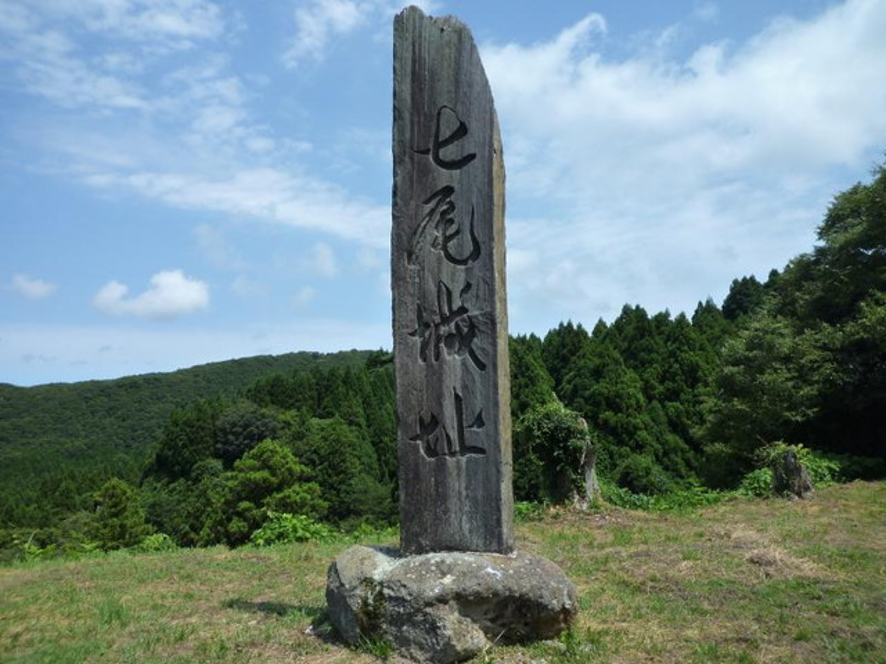
Amidst the fierce power struggles in the Kinai region, the main branch of the Hatakeyama family (Kawachi branch) gradually lost influence. However, the Hatakeyama family of Noto, using the impregnable fortress of Nanao Castle as their base, became a powerful daimyo during the Sengoku period and maintained their independence until Kenshin's invasion. I visited Nanao Castle in the autumn of the year before last, but due to the effects of an earthquake, the stone walls had collapsed and I couldn't go up to the main keep (I was disappointed to be looked down upon by a serow from above), but it seems that it will be accessible from this spring.

The Hatakeyama clan was a rare clan that transitioned from the Taira clan to the Minamoto clan. Hatakeyama Shigetada, one of the meritorious retainers who helped establish the Kamakura Shogunate, was a samurai who, as a main branch of the Kanmu Taira and Chichibu Taira clans, controlled a wide area of northern Musashi Province. He was a man of outstanding character, education, and martial arts, and was called a "model samurai." He was married to the daughter of Hojo Tokimasa, but after the death of Yoritomo, powerful samurai who could oppose the Hojo clan were successively purged, and Shigetada and his son Shigeyasu were finally destroyed by Tokimasa and his son Yoshitoki in a situation that was almost like a treacherous ambush.

Tokimasa, regretting the extinction of the prestigious Hatakeyama clan, a branch of the Taira clan, arranged for his ally Ashikaga Yoshikane's son, Yoshizumi, to marry Shigetada's wife, thus reviving the Hatakeyama clan as a Minamoto clan. There are differing opinions on whether the woman Yoshizumi married was Tokimasa's daughter or the daughter of Yoshitada and Tokimasa's daughter. If the former is true, the Minamoto Hatakeyama clan would have inherited the Ashikaga family through the male line; if the latter is true, it would have inherited the line through Yoshitada's maternal line, meaning the Taira Hatakeyama clan inherited 50% of its lineage.

This case is not just about whether the lineage of the Taira clan's Hatakeyama family continued, but the situation is complicated by the fact that Yoshizumi divorced Nitta Yoshikane's daughter when he remarried Shigetada's wife (or daughter). The sons he had with Nitta's daughter (Tokikane and Tokitomo) were also divorced at the same time and took the names Iwamatsu and Tanaka, respectively.

Having weathered the turbulent times of the Northern and Southern Courts and the Warring States period, the Hatakeyama main family, the Noto Hatakeyama clan, and the Iwamatsu clan all spent the Edo period as hatamoto (direct retainers of the shogun). However, while the two Hatakeyama families enjoyed high stipends of 5,000 koku and 3,000 koku respectively as high-ranking hatamoto, the Iwamatsu family endured on a meager stipend of only 120 koku. The head of the Iwamatsu family, who claimed to be the main lineage of the Nitta clan, made ends meet by drawing cat pictures as amulets. In this respect, they are similar to the Ashikaga family of Awa, who drew and sold protective talismans.

After the Meiji Restoration, peerages were introduced, and the Iwamatsu family, who claimed to be the direct descendants of Nitta Yoshisada, a hero of the Southern Court, were granted the title of baron, bypassing the Hatakeyama family, a high-ranking samurai family. The baron title, usually granted to vassals with a stipend of 10,000 koku or more, equivalent to that of a daimyo, was exceptionally bestowed upon them thanks to their ancestors who raised an army over 500 years ago in support of direct imperial rule. The Iwamatsu family was apparently known as the "Cat Baron."

The Mito Domain, a crucial driving force behind the Meiji Restoration, and the Hatakeyama clan, who survived the medieval and early modern periods like fossils, are connected by a similar heartwarming story. Even in modern times, when the family system has weakened, I think this is a story that would warm the hearts of any Japanese person and make for a good accompaniment to a drink. Incidentally, for me, Mito Komon is played by Eijiro Tono.


Comments