Finally, I'm off to the Shikoku Pilgrimage (Temples 1-10) - Tokushima - April 2026 -

Last year, around the same time, when I visited Tokushima for a relative's wedding, I thought it was about time to start the 88 Sacred Sites pilgrimage. It's such a famous pilgrimage site that I felt it would be a challenging journey (even if you travel by car), so I returned with some mental preparation. From the Yomomi Observatory, you can see the Great Naruto Bridge connecting Shikoku and Awaji Island, and looking back, you can see the city of Tokushima in the distance from Naruto, enjoying a 360-degree panoramic view, just as the name suggests.

More than ten years ago, I spent over a year visiting the 33 Kannon pilgrimage sites of Bando. At the time, I was still a busy department head, so I visited the sites in several trips, using weekends when I didn't have golf. I felt a great sense of accomplishment when I received the "completion" stamp, and the view of the sea off Awa-Tateyama from Nago Kannon felt especially beautiful.

Tokushima (Awa) and Tateyama (Awa) are said to have been closely connected in ancient times, and it is believed that the Imbe clan, based in Awa, rode the Kuroshio Current to land on the Boso Peninsula and developed the area. The Oasahiko Shrine, the Ichinomiya (first shrine) of Awa(阿波), and the Awa Shrine, the Ichinomiya (first shrine) of Awa(安房), share the same principal deity (Ame-no-Futodama-no-Mikoto). The Imbe clan was apparently skilled in the manufacture of hemp and cotton cloth, and the name of the shrine includes the character for "hemp." Furthermore, the "Fusa" in Boso Peninsula is synonymous with "hemp," suggesting a connection between the two regions.

Nearly a thousand German soldiers who were captured during World War I were held here, but it seems to have been a relatively lenient camp, and various cultural exchanges took place between them and the local residents. In gratitude, they built an arched stone bridge in the area, which still remains today.

In the aftermath of the Jōkyū War, the Kamakura Shogunate exiled Emperor Go-Toba, the ringleader, to Oki Island, and also exiled his two successors to distant locations: Sado Island (Emperor Juntoku) and Tosa Province (Emperor Tsuchimikado). Of these, Emperor Tsuchimikado had opposed Emperor Go-Toba's uprising, and was subsequently moved to Awa Province, which was closer to Kyoto, where he later passed away. Awa Shrine was built before the war on the site of Emperor Tsuchimikado's cremation, and having visited Emperor Juntoku's tomb during a recent trip to Sado Island last year, it was a deeply moving experience.

The Jōkyū War was significant not only because it established political dominance for the samurai government, but also because it resulted in several changes in the imperial lineage, laying the groundwork for the later Nanboku-chō period. Emperor Go-Toba had enthroned the son of Emperor Juntoku as Emperor Chūkyō, but the shogunate deposed him and enthroned the son of Prince Moritada, Go-Toba's younger brother by the same mother (Emperor Go-Horikawa). Emperor Go-Horikawa abdicated in favor of his son (Emperor Shijō), but died at the young age of 10 after hitting his head while playing a prank at the palace. The shogunate, not wanting any descendants of Emperor Go-Toba to inherit the throne, struggled to choose a successor, but ultimately enthroned Emperor Go-Saga, the son of Emperor Tsuchimikado, who had opposed the aforementioned uprising. After this, Emperor Go-Saga had his two sons succeed to the throne, and subsequently, both imperial lines (the Jimyōin line and the Daikakuji line) alternated in their succession, which ultimately contributed to the downfall of the Kamakura shogunate and the conflicts of the Nanboku-chō period.

With the advent of the Muromachi period, the authority for local self-government shifted to the shugo (provincial governors) appointed and dismissed by the shogunate. Awa Province, along with neighboring provinces such as Sanuki, Awaji, Izumi, and Kii, came under the control of the Hosokawa family, who served as kanrei (deputy shoguns). Shōzui Castle originated as a shugo office established by the Hosokawa clan, but later the Miyoshi clan, who acted as shugodai (deputy governors), surpassed the Hosokawa clan and became the dominant power, making it the center of the economic base that controlled the Kinai region, including Kyoto.

At the castle site, Kenshoji Temple, the family temple of the Miyoshi clan, is surrounded by a small moat, and the tombs of successive generations are located nearby, leaving some traces of the past. Excavations of the manor site, which began in 1994, are gradually revealing the full extent of the manor complex, including the remains of a large moat. It is rare to find castle ruins from the Muromachi period on flat land, but I felt that this was a result of the natural defensive capabilities of the Yoshino River, which meanders through several large river channels, as well as the political power and military superiority of the Hosokawa and Miyoshi clans.

After destroying the Takeda clan, Oda Nobunaga ordered his third son, Nobutaka, to lead an invasion of Shikoku, but the Honnoji Incident soon occurred, bringing the campaign to a temporary halt. Chosokabe Motochika seized this opportunity, marching north through Awa Province towards unifying Shikoku, capturing Sogō Masayasu of the Miyoshi clan who was holed up in Shōzui Castle, and then heading towards Sanuki Province. However, under Toyotomi Hideyoshi's unification of Japan, which progressed at a faster pace than anticipated, Motochika's administration of Shikoku came to an end in two or three years, and he was once again confined to Tosa Province. In a hypothetical scenario, if Hideyoshi had struggled in the post-Honnōji power struggle with Shibata Katsuie and Tokugawa Ieyasu, the father-son duo of Motochika and Nobuchika would likely have had a considerable presence as part of the warring states.

The pilgrimage to the Shikoku pilgrimage sites begins westward from the upper edge of the Yoshino River alluvial fan. The definition of the Shikoku pilgrimage sites seems to date back to the Muromachi period, but the designated temples and established pilgrimage routes were not finalized until the Edo period. This time, I visited from the first temple, Ryōzenji, to the tenth temple, Kirihataji. In addition to the 88 temples, 20 temples where traces of Kūkai are said to have been gathered after the war to create the Shikoku Special Twenty Sacred Sites, and I also visited the first of these (Ōyamaji). In the end, I will have visited a considerable number of temples: 88 + 20 = 108. This is the same number as the worldly desires, and I would like to carefully eliminate them one by one.
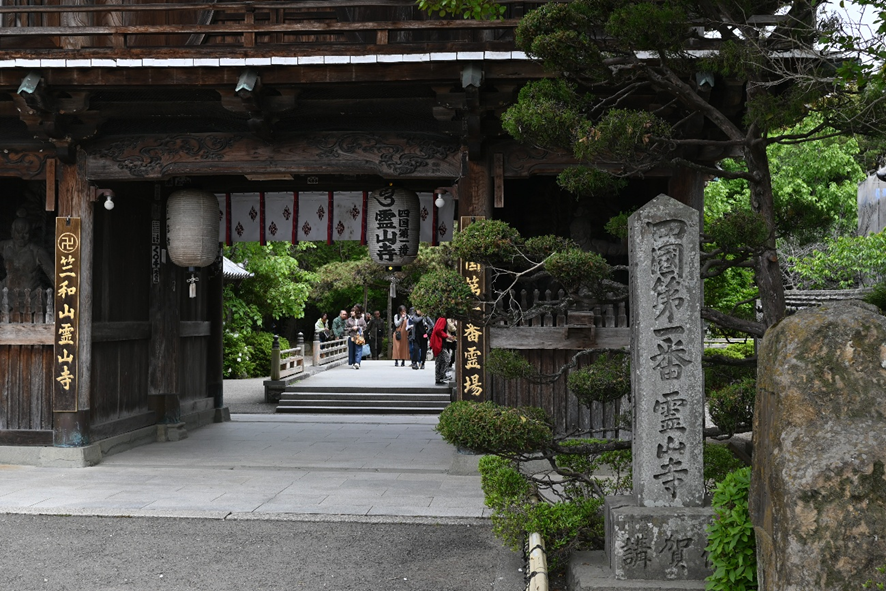
Before entering Ryosenji Temple, I bought a white robe, a Buddhist stole, and prayer beads. The 10+1 temples I'm visiting this time are lined up at relatively short intervals, so it might feel like a smooth start. Being the first temple on the pilgrimage, it was generally very festive, and there was a fair amount of people despite it being a weekday. The Taishido Hall appears to be under renovation.

The long-lived cedar tree at Gokuraku-ji Temple, the second temple on the pilgrimage route, is 1200 years old. It wouldn't be surprising if it were said to have been planted by Kukai himself.

At the third temple, Kinzenji, there is a power stone that is said to have been thrown by Benkei. After the Battle of Ichinotani, Taira no Munemori, the head of the Taira clan, relied on his superior naval power and set up camp at Yashima. It is said that Yoshitsune landed in Awa and prayed for victory at this place before advancing to Sanuki.
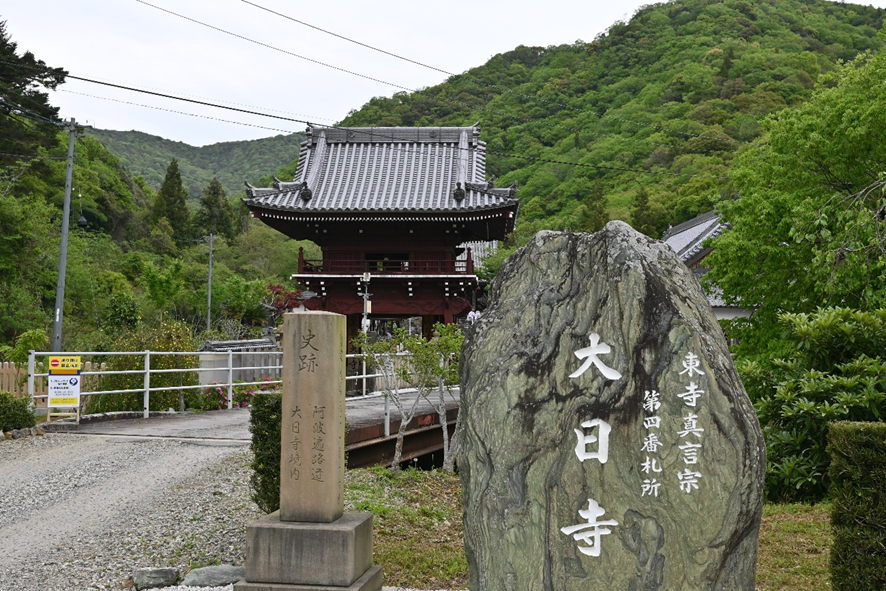
As we enter the mountainside of the Sanuki Mountains, passing through the fourth temple, Dainichi-ji, and the fifth temple, Jizo-ji, we begin a bit of mountain hiking.

Jizo-ji Temple has an inner sanctuary (Gohyaku Rakan-do) built in 1775, where you can worship a 12-meter-tall statue of Shakyamuni Buddha and many standing Rakan statues.
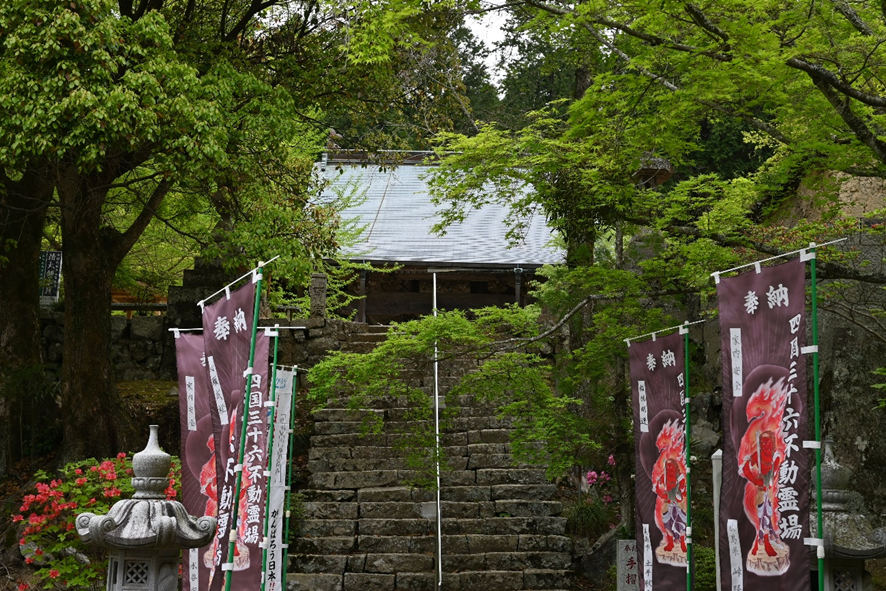
From here, we would normally return to the plains and head towards Anrakuji Temple, the sixth temple on the pilgrimage route, but instead, we went to Daisenji Temple, the first temple on the special pilgrimage route, located deep in the mountains. The steep mountain road meant that the engine of our small, front-wheel-drive rental car was constantly running at full power, and it seemed like it would slip if it rained. Every time I visit mountain temples throughout Japan, I am often impressed, thinking, "How did they manage to build a temple here?" and this is a typical example. An elderly couple who had come from Hokkaido in a camper van had no choice but to park their large vehicle partway up the mountain and walked to the top. They looked tired, but also happy and with a sense of accomplishment.

The special perk of visiting these sacred sites is that you receive one bead at each of the 20 temples, and upon completion, you can make a rosary with them. I'm looking forward to seeing the finished product, so I'll work diligently towards it.

The sixth temple, Anrakuji, is reached by turning back from the mountaintop and descending rapidly to the foot of the mountain.

On the way to the seventh temple, Jurakuji, I came across the Maruyama Kofun (a circular burial mound, 5th century) and was captivated by it for a while. Awa, with its many mountainous areas, has long been a millet producing region, and the Yoshino River basin appears to have been under the control of the Awa no Kuni no Miyatsuko (the governor of Awa Province).

We will head west along the mountainside, following the Yoshino River upstream, to Kumagai-ji Temple (number 8) and Horin-ji Temple (number 9).

The pagoda at Kumagaya-ji Temple was built in 1774 and is said to be the largest and oldest in Shikoku.

As we approached Kirihata-ji Temple, the tenth temple on the pilgrimage route, the atmosphere changed, and we began climbing the mountain path again. From the parking lot beside the temple gate, it seems that we could reach the main hall grounds by climbing 333 steps along the approach road, but my wife accompanying me seemed hesitant. I spotted a road in the distance that looked steep but passable by car, so I followed my intuition and was relieved to find a parking lot near the temple grounds.

Looking up from the main hall, you can see the beautiful Great Pagoda (a two-story pagoda) towering above. After the Battle of Sekigahara, Tokugawa Ieyasu tried to weaken the Toyotomi family's wealth and repeatedly urged Hideyori to build or repair shrines and temples. The pagoda built at the Jinguji Temple of Sumiyoshi Taisha Shrine is one such example. After the Jinguji Temple was abolished during the anti-Buddhist movement in the Meiji era, the pagoda was relocated here and is now designated as an Important Cultural Property. We are grateful for the foresight of the head priest at the time.
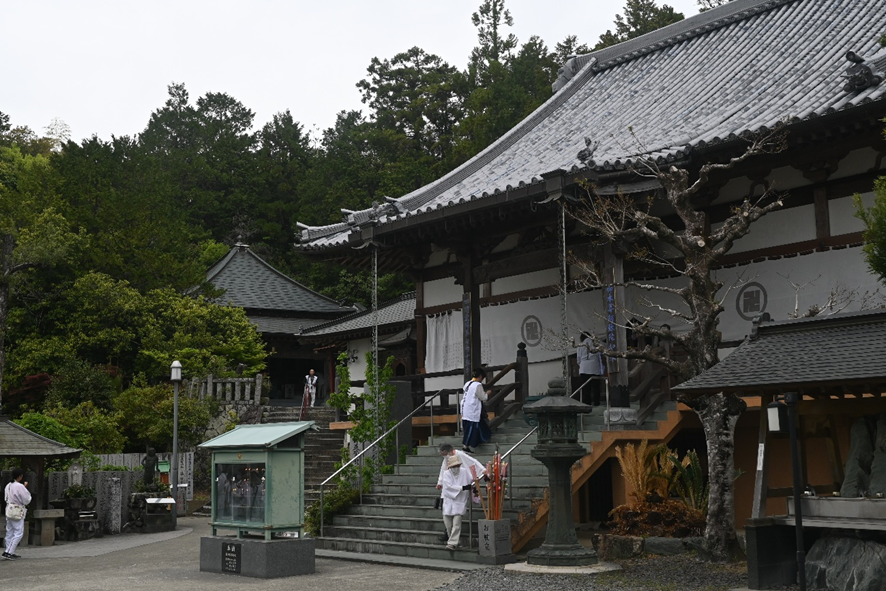
The pilgrimage route crosses the Yoshino River from here, then heads east before descending south from Tokushima City. The route within Tokushima Prefecture, which has a relatively large amount of flat land, seems relatively smooth, but there are several difficult sections to anticipate, so I want to plan my strategy carefully and prepare to enjoy Shikoku. Walking is the proper way to do the pilgrimage, but even if you use a car, visiting just ten temples will easily exceed 10,000 steps, including uphill sections. I've always wanted to go, but I should do it while my legs and back are still strong.
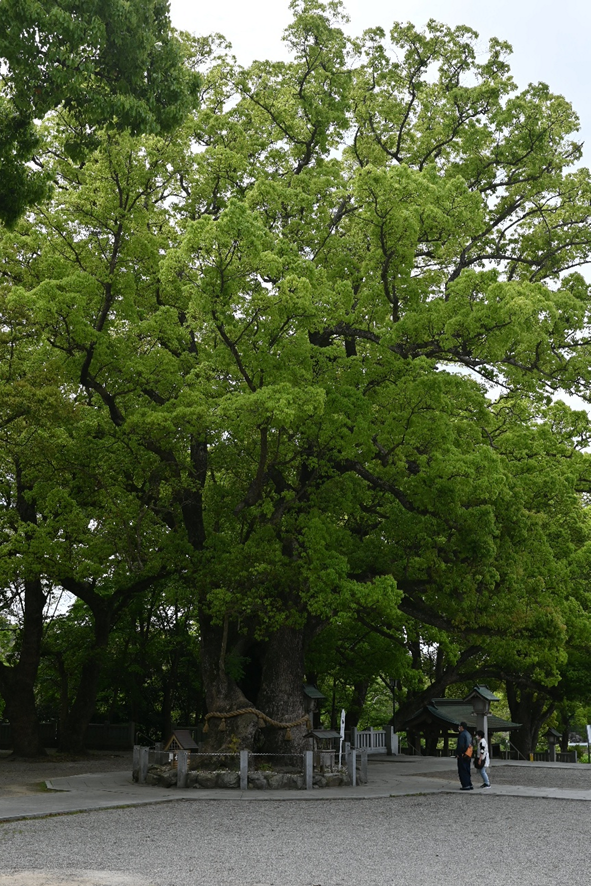
The camphor trees at Oasahiko Shrine are over a thousand years old, and I was overwhelmed by their lush green foliage. I couldn't complain about tired feet or a sore back.


Comments