Shima Province ~FEB,2026~

The Engishiki, compiled in the 10th century, classifies the 60-odd provinces established under the Ritsuryo system into four ranks: Dai, Jo, Chu, and Ge, based on their national power. Shima is one of the nine designated Ge-koku provinces, a small peninsula with only two counties and little flat land, making it an area with low agricultural productivity. However, since ancient times, it has been valued as a "Miketsukuni" (food province) that supplied the Imperial Court with seafood, along with Wakasa and Awaji. Lighthouses line the coastline at key points, where maritime traffic is fraught with obstacles. Anorisaki Lighthouse is located at the midpoint of the peninsula's coastline, which is also the entrance to Matoya Bay, which divides Shima in two.
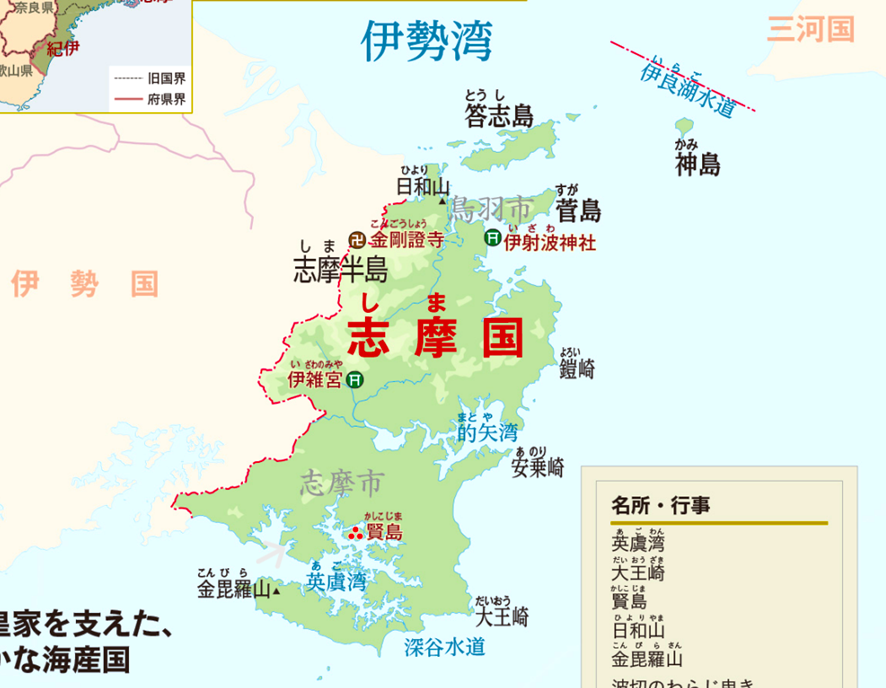
Last summer, I made my first-ever pilgrimage to Ise Shrine, staying on Kashikojima Island, but ended up taking a detour via the Isewan Expressway to Shima, a drive of over 500km one way. This time, I decided to change things up a bit and headed to Toba on a car ferry from Cape Irago, at the tip of the Atsumi Peninsula. The boat trip was about an hour, but it was a relaxing time, allowing me to eat my lunch or take a nap while looking out at the islands at the entrance to Ise Bay.

Along the way, announcements are made about the islands. Kamishima, which comes into view shortly after leaving Irago, is the setting for Yukio Mishima's novel "The Sound of Waves." After doing some research, I found out that it has been made into a movie five times, with the island being used as a filming location for each. However, the most memorable one is the one starring Tomokazu Miura and Momoe Yamaguchi. It was released in 1975, so half a century has passed since then.

Toshijima is a long, narrow island lying near Toba Port, with a population of about 1,600 people living within an area of two or three stations on the Yamanote Line. The island has such a long history that Hitomaro wrote about it in the Manyoshu, and it is the place where Kuki Yoshitaka, who sided with the Western Army in the Battle of Sekigahara, committed suicide.

During the Battle of Sekigahara, many feudal lords were troubled as to whether they should side with the East or the West, and there were quite a few cases in which parents and siblings split into allies and enemies in order to maintain their family names, such as Kuki Yoshitaka and his son Moritaka. Moritaka immediately begged Ieyasu for his father's life after the war ended and was pardoned, but Yoshitaka committed suicide before receiving any word of this.

The Sanada family's "Inubusi Farewell" is famous, but in Sanada's case, his father Masayuki and second son Yukimura, who joined the Western Army, escaped the death penalty, but were forced to retire to Mount Koya, and the outcome was passed on to the Battle of Osaka.

Yoshitaka Kuki served the Oda and Toyotomi clans as the commander of the navy, defeating the Mori navy during the siege of Ishiyama Honganji Temple and leading the Nippon Maru during the Bunroku War, and as a daimyo of the Toyotomi clan he built a modern castle (Toba Castle). The Otemon Gate appears to have faced the sea, but in front of the Sannomaru, below the Honmaru, the Kintetsu Shima Line and a road run through it, and you can see the ferry terminal and aquarium at Toba Port.

In the Meiji period, the main castle was demolished and an elementary school was built there, and few traces remain from that time except for the stone walls, but the location made it easy to defend and allowed for attacks at any time, and one can sense the pride of the naval governors Oda and Toyotomi.
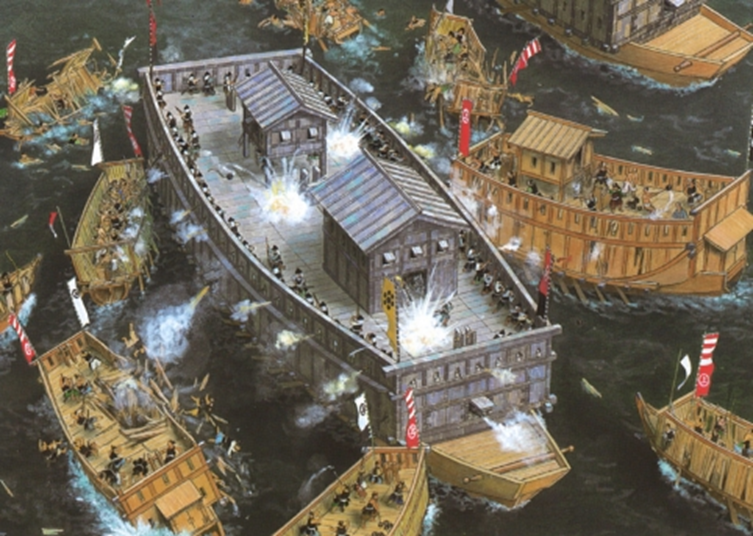
It is said that Yoshitaka cut down the sacred tree of Kata Shrine at the foot of the castle, built the Nippon Maru, and set out for Korea.

After the Battle of Sekigahara, Moritaka inherited 56,000 koku of land in the Toba domain, but he protected Joan-ji Temple, which his father Yoshitaka had been a devout believer in, as his family temple.

The Toba domain of the Kuki family was protected by father and son, but a dispute over the succession arose between Moritaka's sons, and the shogunate intervened, resulting in the transfer of the domain. Hisataka, the fifth son, inherited the family lord's estate according to the will, but Takasue, the third son, opposed this, and in the end, the former inherited the Settsu Sanda domain with 36,000 koku, and the latter the Tamba Ayabe domain with 20,000 koku. The Kuki family moved inland and lost their naval power. Both domains remained in this state until the Meiji Restoration.

The Mita clan, the lord of the castle, dug a pond in front of the castle and floated boats in it so that they would not forget how to operate a boat even after moving inland.

Incidentally, Shirasu Jiro was from a family of Confucian scholars in the Sanda domain, and his wife's grave is at Shingetsu-in Temple in Sanda city. It's a town I'd definitely like to visit in the future.

The site of Shima's provincial capital has not been confirmed, but there is a successor temple to Kokubunji Temple, built on the site of the former Kokubunji temple. The temple was rebuilt after the Onin War, and the principal image of the temple, the Yakushi Nyorai statue, was erected in the early 16th century. The head priest, who happened to be there, kindly gave us a detailed explanation and kindly allowed us to view the secret Buddha statue from the side. The main hall, built during the Tenpo era, is very charming and complements the early-blooming cherry blossoms beautifully.
I decided to wander around some of the temples and shrines that I wasn't able to visit during my pilgrimage to Ise Shrine last year.

Koubenomiya Yomo Shrine is a shrine that grants blessings to the "head," and its enshrined deity is said to be Karahashi Chujo Mitsumori, though his existence is questionable. The origin of the name is said to be that a skull floated down the Karako River near the shrine, and Mitsumori's spirit told the shrine that he should be worshipped, which is a strange story. It is said to grant wisdom and protect the head, and is popular with students taking exams as well as motorcyclists.

Takihara Shrine is a branch shrine of the Inner Shrine of Ise Jingu, and is said to have been the location originally chosen by Yamatohime-no-Mikoto, who was searching for a final resting place for Amaterasu Omikami. This shrine also undergoes a relocation every 20 years, and the planned site for the next shrine is adjacent to it. In addition to the main shrine of Ise Jingu, Ise-Shima also has many branch shrines, and it would be interesting to visit them and research the significance of each (incidentally, there are 10 branch shrines in the Inner Shrine and 4 branch shrines in the Outer Shrine).

There are two shrines called Ichinomiya in Shima. One is Izawa-no-miya, a branch shrine of the Inner Shrine of Ise Jingu, and the other is Izawa-jinja, located by the sea near downtown Toba city. I came to the latter intending to stop by before boarding the ferry, but my expectations that it would be an easy visit because it's Ichinomiya were dashed as it turned out to be quite a climb. It's about a 1km trek from the parking lot to the main shrine, and here Izawatomi-no-mikoto, who welcomed Yamatohime-no-mikoto, is enshrined, suggesting a connection to Ise Jingu.

It is a mystery why part of this small peninsula was carved out and made into a "country" when the ancient Ritsuryo system was established, but it is thought that it was not only a valuable supplier of seafood to the Imperial Court, but also an important place of worship as the hinterland for Ise Shrine and the home of the gods. The most recent ice age ended 20,000 years ago, and sea levels have risen by about 100m since then, but the spectacular scenery of the miraculous ria coastline is the result of the mountains and valleys that once eroded into the sea. The ice age cycle is said to be 100,000 years, so we will be able to enjoy this spectacular view for a while.


Comments