Sakai: From ancient times to the early modern period - FEB, 2026 -

Ever since I saw NHK TV drama "Golden Days" as a junior high school student, my wish to visit Sakai has finally come true. Daisen Park stretches between the tombs of Emperor Nintoku and Emperor Richu, and is home to many of the tombs of the Mozu Kofun Group. Even when viewing the tombs from a flat area, the large ones in particular resemble a dense forest, making it difficult to grasp the full picture. However, I heard there was a service offering a hot air balloon ride that went up to 100 meters, so I braved it and took a ride.
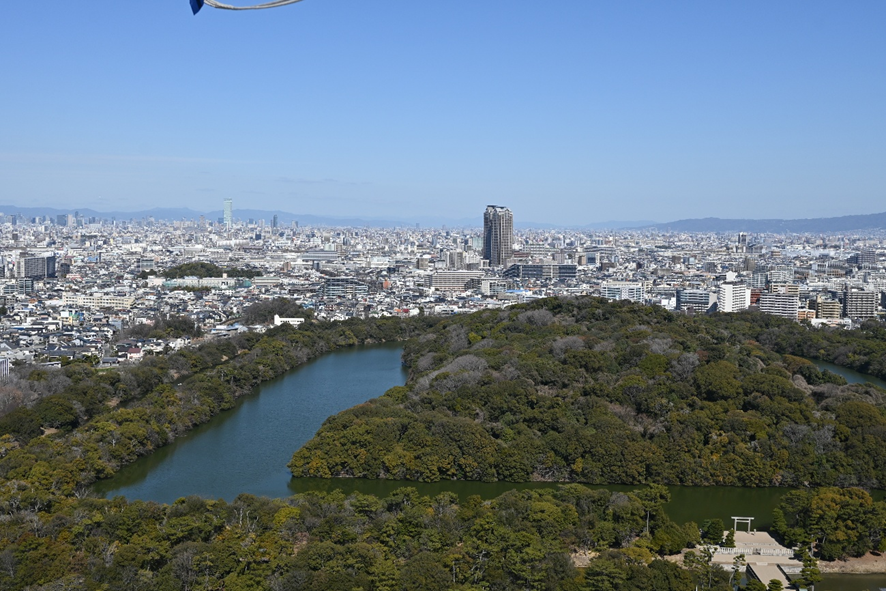
Due to my fear of heights, I ended up crouching down as we went up, but I was able to see the entire Daisen Tomb and Sakai city. Large buildings include the Sakai City Hall in the foreground and Abe no Harukasu in the distance.

The construction of the Mozu Kofun Group in Sakai and the Furuichi Kofun Group in neighboring Fujiidera corresponds to the era of the "Five Kings of Wa," a time when the Yamato dynasty unified the country, paid tribute to continental dynasties, and expanded international relations. The imperial tombs established from the late Edo period through the Meiji period have recently come under scrutiny as scientific approaches have evolved, leading to changes in the names we learned about them as students. Currently, the former tomb of Emperor Nintoku is called the Daisen Kofun, and the former tomb of Emperor Richu, located south of the park, is called the Kamiishizu Misanzai Kofun. While the order of accession was Nintoku followed by Richu, the most recent dating suggests that the latter is older (early 5th century). We hope that future full-scale research will shed light on this and other examples.

The Yamato River, which flows east and west of Sakai, has collected rivers from the Nara Basin since ancient times, crossing the Ikoma and Kongo mountains before flowing into Lake Kawachi, but from the Kofun period through the Middle Ages the lake gradually filled in and turned into flat land. The Nihon Shoki describes Jimmu's Eastern Expedition as an invasion of the Nara Basin from Lake Kawachi, passing the tip of the Uenodai Plateau where Osaka Castle stands, but in the 4th and 5th centuries the area became a place where large mausoleums were built to demonstrate the authority of unified dynasties both at home and abroad. The grandeur of the Daisen Kofun was apparently visible from the sea at the time.

There are apparently 44 Mozu Kofun Tombs remaining, and I walked around the area, seeing the main burial mounds and shrines. Crossing the JR Hanwa Line from Daisen Park, you'll find Itasuke Kofun, where housing development was stopped midway. From here, the 146meter moated tomb looks ordinary.
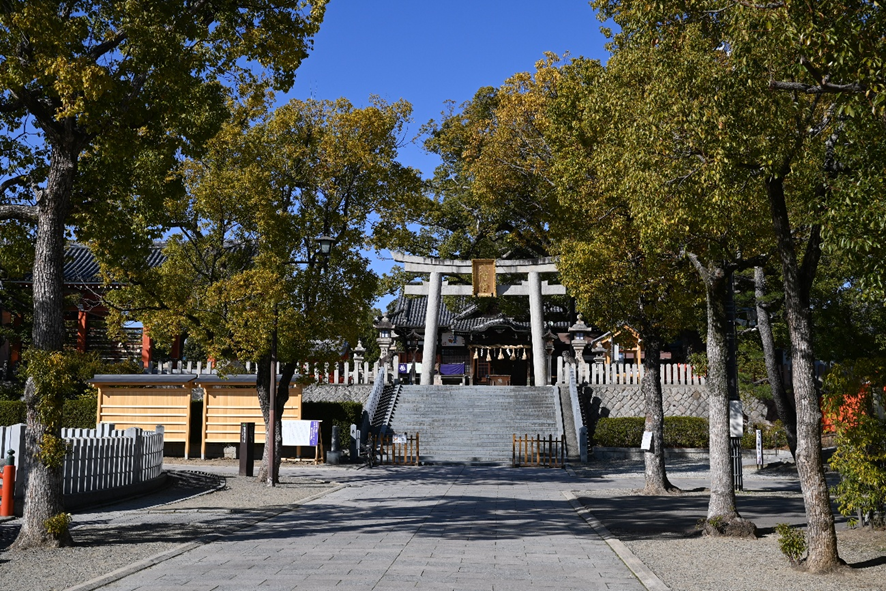
The Gobyoyama Kofun is rather large (203m) and is designated by the Imperial Household Agency as the tomb of Emperor Ojin and Empress. Emperor Ojin's tomb is located in the Furuichi Kofun Group, but the Empress is also believed to be buried closer to her son (Daisen Kofun). However, a short walk from the rear circular mound leads to Hachiman (Mozu Hachiman Shrine), the deity of Emperor Ojin.

A few hundred meters from here you will find the Haji Nisanzai Tomb, which is over 300 meters long. The Imperial Household Agency has determined that it is the tomb of Emperor Nintoku's Empress (Iwanohime no Mikoto), but because it dates back to the second half of the 5th century and is newer than the reign of Emperor Nintoku, and because of its size, it is thought to have belonged to another great king, further deepening the mystery here.

On the other hand, Tabei Tomb (the tomb of Emperor Hanzei) near Sakai-Higashi Station is less than half that size. I walked while looking at a map, and strangely enough, while the Tabei, Daisen and Kamiishizu Misanzai Tomb all face roughly the same direction, north, the Itasuke, Gobyoyama and Haji Nisanzai Tomb all face east. The latter appears to have been built facing the Furuichi Tomb Group, and this orientation may also have had some intention behind it being the burial site. Next to Tabei Tomb is Houchigai Shrine, which is said to date back to the period when the tombs were constructed.

Within the temple grounds stands a stone monument marking Mikunigaoka, which indicates that this area was the border between the three provinces of Settsu, Kawachi, and Izumi. Izumi Province was separated from Kawachi Province in the second year of the Reiki era (716) at the beginning of the Nara period, and with no prominent mountains or rivers to mark the border, the Tabei Tomb on the northern edge of the Mozu Tomb Group may have served as a good border marker. If you cross the Hanshin Expressway to the west from here, you will enter the streets of old Sakai, where the era changes from ancient times to the medieval and early modern periods.

Before entering the autonomous city of Sakai, I visited Eharaji Temple, which was built by Gyoki. Given the season, many offerings of prayers for success in exams were hanging in the main hall. Gyoki is said to have built 49 temples in the Kinai region, and this temple is famous for its wisdom and academic success. A retired man like me may be out of place, but I prayed for guidance as I wander through the forests of history.

Otori Taisha Shrine is located along the old Kumano Kaido road, which ran through Kishu before the Edo period. Taira no Kiyomori and his son Shigemori were on their way to Kumano to make a pilgrimage when the Heiji Rebellion broke out (Minamoto no Yoshitomo and Fujiwara no Nobuyori imprisoned Emperor Goshirakawa). Upon hearing the news, they prayed for victory at Otori Taisha Shrine, returned to Kyoto, and the era of the Taira clan began. Since it is considered auspicious, I will also pay a visit before entering the city of Sakai.

Nanshuji Temple was built by Miyoshi Nagayoshi to commemorate the soul of his father, Motonaga. It was burned down when Sakai was burned down by the Toyotomi forces during the Summer Siege of Osaka, but was later rebuilt by the monk Takuan, who became the chief priest. The graves of Miyoshi Nagayoshi and Sen no Rikyu's family are lined up, and the temple was also under the patronage of the Shogunate during the Edo period.

After the Battle of Osaka, the Tokugawa era settled down, and Tokugawa Hidetada and his son Iemitsu visited here. Perhaps because the Toshogu Shrine was enshrined within the temple, a legend arose that Ieyasu was killed by Goto Matabei's spear during the Summer Siege. The Toshogu Shrine was burned down during the Sakai air raid, but Konosuke Matsushita apparently built Ieyasu's tomb on its site. The head priest explained to me in detail that after the war, when Matsushita struggled to sell sockets in Osaka, it was Mr. Miki, a descendant of a former Mito domain elder, who helped him. Thanks to this connection, the TV broadcast of "Mito Komon" began with sponsorship from Matsushita Electric. I loved the show, so I hope it will be re-aired.

Incidentally, Mr. Miki is a descendant of Nagaharu Bessho, who resisted Hideyoshi at Miki Castle, and apparently took the name Miki when he served the Mito Domain. Hideyoshi often spared the castle soldiers in exchange for the castle lord's suicide. This was also the case at Bitchu Takamatsu Castle, Tottori Castle, and Oshi Castle.

Photography is prohibited inside Nanshuji Temple, and although there are several sub-temples with a long history within the temple grounds, they are all off-limits. The plum blossoms were in full bloom, so it was a tranquil experience that was a feast for the eyes. From here, we walked north through the city of Sakai.
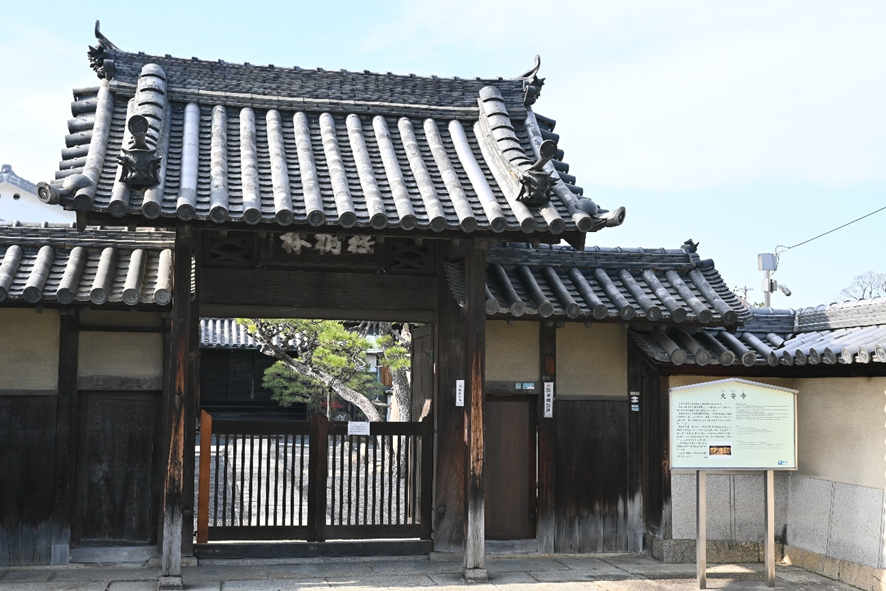
The main hall of Daian-ji Temple was apparently relocated from the residence of Naya Sukezaemon. I couldn't go inside, so I looked at it from the outside, but I was fascinated for a moment, thinking that it must be the home of Luzon Sukezaemon, the protagonist of Golden Days.

Nobunaga and Hideyoshi gradually stripped the city of its authority and its defensive functions, but remains from that time remain in parts of town. The widest moat was 15m wide and 4.5m deep. Incidentally, the moat width of Nagoya Castle was 25m, and that of Edo Castle's Otebori was 48m, so this was an unusual defensive facility for an autonomous city in the Muromachi period.
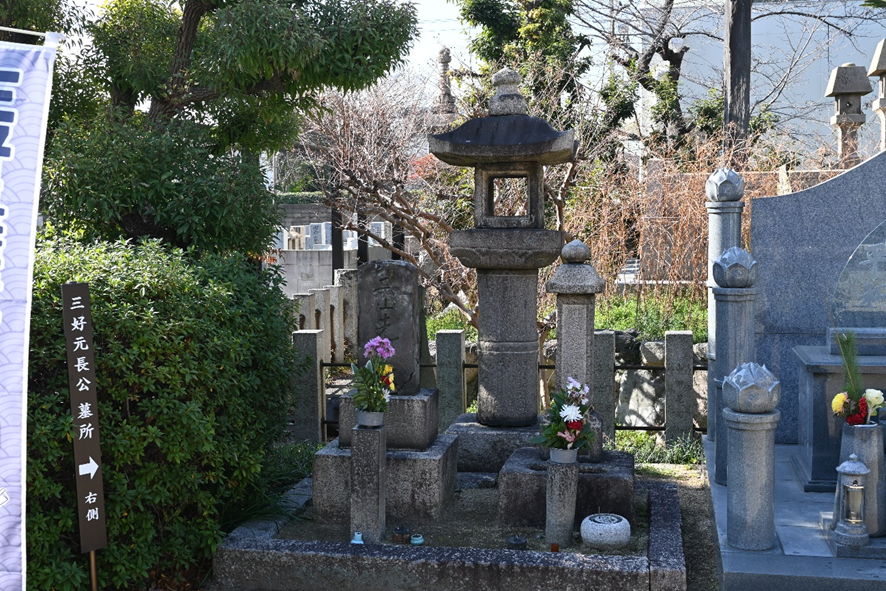
Hosokawa Harumoto and Miyoshi Motonaga supported Yoshitsuna, the younger brother of Ashikaga Yoshiharu (the 12th Shogun), as a possible successor and based themselves in Sakai, but they later fell out and Motonaga was attacked by Harumoto and committed suicide at Kenpon-ji Temple. Yoshitsuna fled to Awa, and his son Yoshihide (the 14th Shogun) was later proclaimed Shogun and served for a short period but was never allowed to enter Kyoto, and this family became known as Hirashima Kubo in the Edo period and received a small stipend from the Hachisuka family (see separate article, "The Ashikaga Shoguns of Awa").
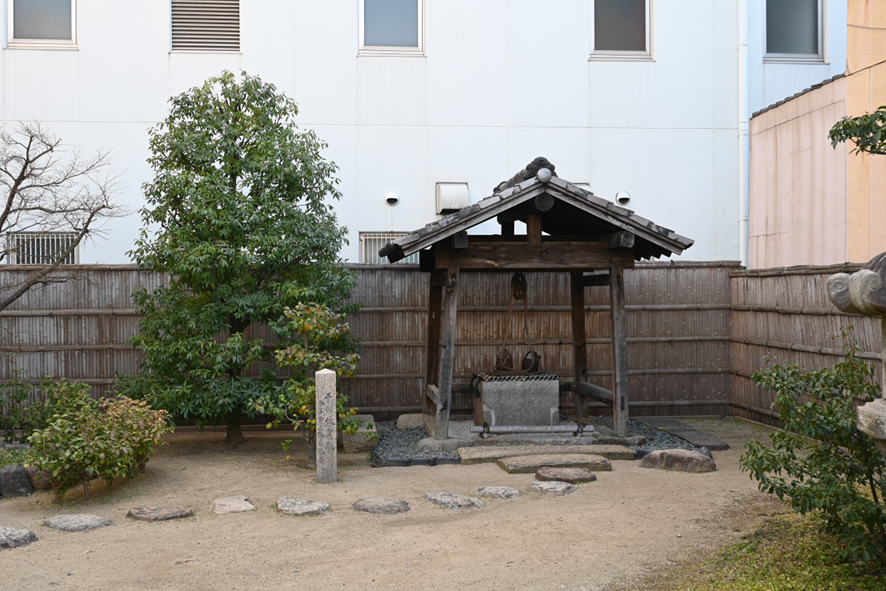
At the site of Sen no Rikyu's residence, there was a "Camellia Well" and a roofed building that covered it. It is said that the materials used were from the Kinmokaku Pavilion at Daitokuji Temple, which was the inspiration for Rikyu's decision to build his own temple.

The remains of Yosano Akiko's birthplace are located along the old Kishu Kaido road. She apparently ran a confectionery business.

It is said that the head priest of the nearby Kakuo-ji Temple mediated the reconciliation between Tekkan and Akiko.

As you'd expect from Sakai, there is a monument marking the border between Settsu and Izumi, and it seems that the town of Sakai itself was also divided into administrative districts north and south here.

Xavier Park is home to a variety of monuments, but the stone pavement is set along the medieval coastline. As the functions of Hyogo Port (Owada no Tomari) declined during the Onin War, Sakai, which was a fishing port, became increasingly prosperous as a commercial port.

The reason Sakai reached its peak in the 16th century seems to be that in addition to its port function, the skills and traditions of metalworking that had been rooted in the area since the Kofun period were also a major factor. At the Gunsmith House, we learned about the background to the stable management that continued in Sakai, which was under direct control of the shogunate, and about the manufacture of guns. This is the origin of Sakai's current bicycle and cutlery manufacturing industries.

During the aforementioned Summer Siege of Osaka, Toyotomi forces suspected the town of being a Tokugawa logistics base, and the town was burned down, but during the Genna era, the town was laid out in a grid pattern, and remains so to this day. Traces of the medieval autonomous city are hard to find, but there seems to be a layer of earth about one meter below from when the town was burned down, and excavations have been uncovered that hint at its glory. The earthen walls of Gekkoji Temple were built using roof tiles that had burned down at the time.

Myokokuji Temple was the regular lodging in Sakai for many generations of rulers and famous military commanders, including Nobunaga. Until Nobunaga carried Yoshiaki into Kyoto, it could be said that the four Miyoshi brothers, led by Nagayoshi, were the closest to ruling the country, but it was founded by the younger brother, Jitsuyasu, who effectively controlled Awa and Shikoku, which could be considered the Miyoshi family's logistics base. The temple's storehouse survived the Sakai air raids, and many historical heritage sites remain, making it a place worth visiting.

It is famous for its large cycad (1,100 years old), but when Nobunaga once moved it to Azuchi Castle, it was chopped up and returned because it made an eerie noise. Ieyasu, who came as a tourist, enjoyed the garden designed by Kobori Enshu, but then the Honnoji Incident occurred and this is where the great escape of the "Divine Lord over Iga" began. He is said to have traveled the 150km from Sakai to Mikawa in three days. There are various theories about his route, and Chogakuji Temple on the Yamanobe Road, which I visited last autumn, is one of the theories that he was hiding out at that time.

Although Sakai's port functions were declining due to the sediment brought in by the Yamato River, it seems to have still been functioning during the Meiji period, and a lighthouse was built there in 1877. It is the oldest wooden lighthouse and is a nationally designated heritage site. Sakai, which flourished as an advanced region of Japan from ancient times to modern times, was a coveted place for history buffs. I would like to deepen my understanding of the area, including the Furuichi Kofun Group, in the future.

This time I stayed overnight near Sakai-Higashi Station and had a drink at a kushiage restaurant, and in addition to the kushiage, the doteyaki (beef tendon stew) was delicious.


Comments