Yamato's northernmost point: Akita ~MAY, 2026~
Updated: May 20

Located on the outskirts of Akita City, the Omoriyama Observatory sits atop a low mountain only 124 meters above sea level, yet offers panoramic views of Akita City stretching from the Oga Peninsula to the north. To the south, you can see the snow-capped Mount Chokai in the distance, creating a magnificent panorama—a testament to the vastness of the alluvial plain formed by the Omono River.

After the Battle of Sekigahara, Satake Yoshinobu was ordered to relocate to Akita, and he went directly to his new post from Kyoto without stopping in Mito. It was clearly a demotion and he must have been unhappy about it, but it is said that his mood improved after crossing the Yuzawa Pass and seeing the fertile land, and the pass was named Gokigenzaka (meaning "mood-improving slope").

According to the Nihon Shoki, Emperor Sujin appointed four members of the imperial family as generals and had them conquer Tokai, Saikai, Koshi (Echigo), and Tanba. Of these, it was Ōhiko-no-mikoto, Emperor Sujin's uncle, who led his troops into the Hokuriku region. From then on, the Yamato court aimed to expand its territory northward until the Nara period, and in 733 AD, they built Akita Castle.
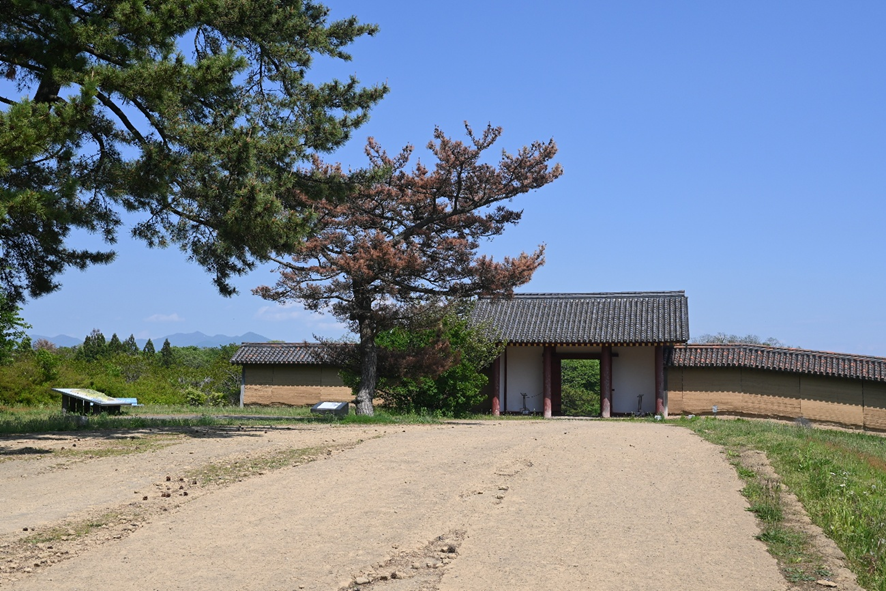
The nearby Koshio Shrine enshrines Takemikazuchi-no-kami and Ohiko-no-mikoto. The former is the principal deity of Kashima Shrine, who directly negotiated the transfer of the land and contributed to Emperor Jimmu's eastern expedition, while the latter is a hero of the conquest of the Sea of Japan side, who is thought to have actually reached as far as northern Niigata Prefecture. According to shrine tradition, the shrine was built in the 7th century by Abe no Hirafu, who advanced northward along the Sea of Japan side and subjugated the Emishi people.

During the Nara period, the Tohoku region was a frontier, a cutting edge for territorial expansion northward. However, with the advent of the Heian period, the political landscape of Tohoku entered a period of contraction and stagnation. The provincial capital of Dewa Province was initially located at Akita Castle, but was later moved to Kinowa Fort in Shonai, and appears to have been abandoned by the mid-10th century. Following this policy shift, the imperial court had virtually no national army, something that would have been possible only in an island nation (hence the considerable panic during the Toi invasions).

It feels like fate that the Satake clan, descendants of Shinra Saburo Yoshimitsu, became the lords of Akita. Yoshimitsu was the younger brother of Yoshiie, who played an active role in the Former Nine Years' War and the Later Three Years' War. He joined forces with Yoshiie and destroyed the Kiyohara clan at Kanazawa Fort in Yokote.

Coincidentally, the Nanbu clan of Morioka Domain, who crossed the Ou Mountains, also belonged to the Yoshimitsu lineage. Yoshimitsu's sons, the main line, adopted the name Satake, while his younger brother branched off as the Kai Genji, becoming the Takeda, Ogasawara, and Nanbu clans, passing down their lineage until the Meiji Restoration. The descendants of Yoshiie ruled Japan three times—under Minamoto no Yoritomo, Ashikaga Takauji, and Tokugawa Ieyasu (whether this is true or not is another matter)—while the descendants of Yoshimitsu played a supporting role in their rise to power.
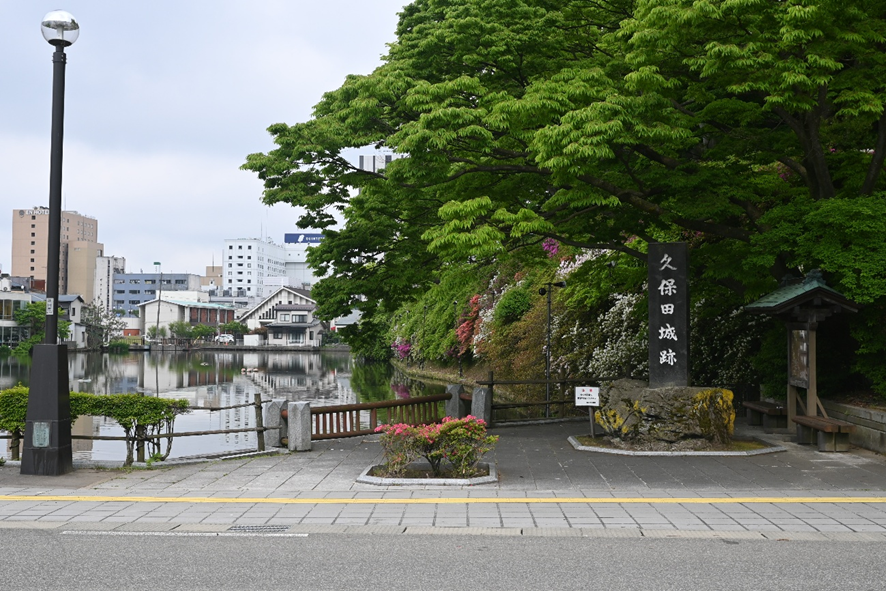
When Satake Yoshinobu first took up residence in the domain, he moved into Minato Castle, the former residence of the Akita clan, but found it too small and immediately began construction of Kubota Castle. He used very little stonework, instead relying on earthen ramparts and moats, and did not build a keep. This was likely the Satake style, similar to that of Mito Castle. Alternatively, it may have been out of consideration for the Tokugawa family or a need to save money due to a decrease in income (from 540,000 koku to 200,000 koku), but it also suggests a sense of balance and a relaxed attitude that comes from having survived from the Heian period to the Sengoku period, without being bound by ostentation.

Near Ninomaru is the Yataka Shrine, dedicated to Hirata Atsutane. The shrine's stone marker was inscribed by Marquis Satake Yoshiharu. Lord Satake, who withdrew from the Ouetsu Reppan Alliance early and sided with the new government forces, was granted the title of Marquis. In contrast, the Date family, who were the leaders of the alliance, had their territory reduced (from 620,000 koku to 280,000 koku) and were later demoted to the Earl. The Aizu Matsudaira family, who resisted to the end, had their territory drastically reduced (from 280,000 koku to 30,000 koku) and were forced to settle for the title of Viscount. The system of rewards and punishments during the Meiji Restoration sometimes created tragedies and regional injustices.
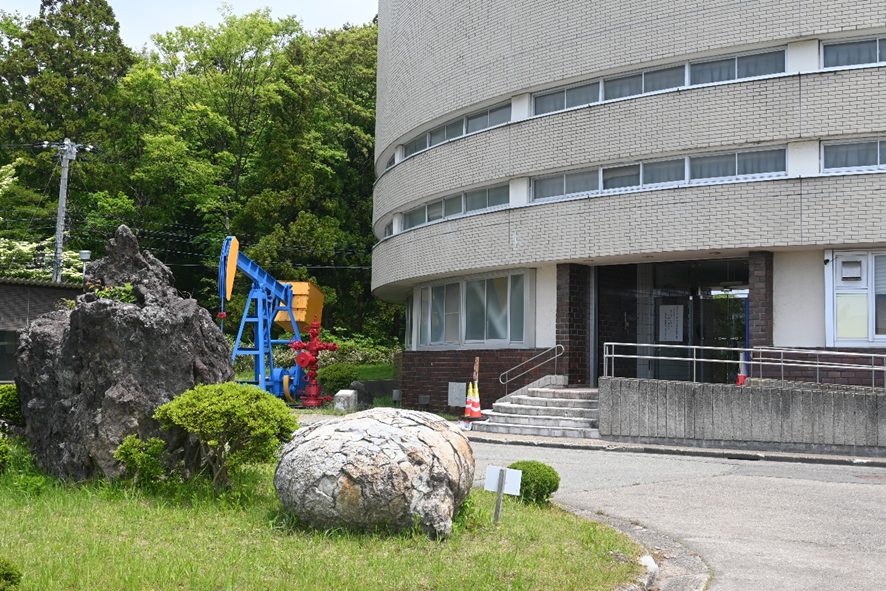
Hirata Atsutane's grave is located in the northeastern part of Akita City, near Tegatayama Park, where Akita University is located. The university's mining museum is nearby, and I had always wanted to visit it if I had the chance, given my background in the energy industry. Akita is rich in mineral resources and has one of Japan's leading oil fields, and the university's flagship department used to be the Faculty of Mining, but it has now been renamed the Faculty of International Resource Sciences. It has a considerable collection of rocks and minerals, and is a must-see for anyone interested in geology.

It seems that living things generally tend to grow larger during the course of evolution. Some ammonites from the Cretaceous period, before their extinction, were about 2 meters in diameter, and I once saw one about 1 meter in diameter being sold for 2 million yen in Canada. Regardless of the price, I would hesitate to bring one home, but I have a few that are about 10 centimeters in size, which I was able to easily buy as souvenirs.

Apparently, bears frequently appear in the area, so I hesitated to go to Atsutane's grave, which should be nearby.

I visited Tentoku-ji Temple, the family temple of the Satake clan. The main hall and study, which are designated as important cultural properties, were under construction, so I couldn't go inside, but I was able to admire them from afar. The mausoleums of the feudal lords and their families are neatly arranged here, giving the temple a dignified atmosphere. When traveling around the country, I often visit temples associated with former feudal lords, but there are many cases where they have been abandoned due to the anti-Buddhist movement or have fallen into disrepair due to the loss of their economic base. Although it is a high-ranking temple and the threshold is high, it is reassuring to see that it is properly maintained.

Nearby was the Joshitei, which was the villa of successive feudal lords. When you think of daimyo gardens, you imagine vast and luxurious places, but this one has a world of its own in its simplicity. The azaleas were in full bloom, and I enjoyed them from the veranda.

Taiheizan Miyoshi Shrine is where Sakanoue no Tamuramaro prayed for victory in battle. Although the main hall is located within Akita City, it is situated on the summit of Mount Taihei, at an altitude of 1171 meters, and it is said that worshippers can only climb to the top for two months during the summer.

A thousand years after Tamuramaro's visit, Lord Kujo Michitaka, the commander-in-chief of the Oshu Pacification Force during the Boshin War, also paid his respects here. I prayed for world peace, and in the evening, I solemnly enjoyed a fine sake bearing the name of "Taiheizan."

In the southwest corner of Kubota Castle, there is a cluster of temples that the Satake clan gathered when developing the castle town, creating a charming atmosphere perfect for a stroll. Many of these temples were moved from Hitachi when the Satake clan was transferred to another domain, and Rinshoin Temple is one of them. In the Meiji era, when it was damaged by fire, it was granted the back gate of Kubota Castle and used as its main gate.

Komyoji Temple is said to have been built by Hojo Tokiyori, the fifth regent of the Kamakura shogunate, and there are many temples throughout Japan that are associated with Tokiyori. Tokiyori is associated with legends of "traveling around the country," similar to Tokugawa Mitsukuni of Mito, and his actual activities are unclear. At the very least, Kenchoji Temple, which he built during his time as regent, and Saimyoji Temple (now Meigetsuin), which he built when he became a monk, were built by Tokiyori. After the Jokyu War, many of the jito and shugo (land stewards) in the Tohoku region were members of the Hojo clan, so it is certain that the Hojo clan exerted a great influence throughout Tohoku.

Now, when the Satake clan entered the region, the Akita clan, who had been granted control of northern Akita Prefecture by Toyotomi Hideyoshi, had been known as the Ando clan until they pledged allegiance to Hideyoshi. They were a powerful local clan representing northern Oshu during the medieval period, with bases in Hiyama, Tsugaru Tosaminato, the Oga Peninsula, and Tsuchizakiminato (Akitaminato), and had a strong financial base through trade with the Sea of Japan and Ezo (Hokkaido). Ultimately, however, they became a Sengoku daimyo and established themselves in this region. They claimed to be descendants of the Abe clan, which was destroyed in the Former Nine Years' War, but ironically, they were once again driven out by the Minamoto clan.

After being transferred to Hitachi Shishido, the Akita clan was moved to Miharu, a town known for its beautiful cherry blossoms, where they remained until the Meiji Restoration. Wakimoto Castle, the former residence of the Ando clan during the Sengoku period, is located at the base of the Oga Peninsula and is designated as one of Japan's Another 100 Famous Castles. From the castle ruins, a cluster of wind turbines off the coast of Akita was visible.

Last summer, I followed in Basho's footsteps, traveling from Kisakata to Sakata and Tsuruoka, while admiring Mount Chokai along the way. Although the Edo period was a time of little mobility, there are other traces of travelers. Sugae Masumi left his hometown of Mikawa and wandered through Dewa, Mutsu, and Ezo, but after reaching middle age, he settled in the Kubota domain, leaving behind many travelogues that convey the customs of the time to this day. Although he lived more than a century after Basho, he too visited Kisakata before the Kisakata earthquake (1804).

It is said that the imperial court in Heijo-kyo sent a considerable number of immigrants (sakuko) from other provinces when constructing Akita Castle, but initially, as it was still a frontier, human resources for agriculture and military purposes were probably scarce. I stopped by the Edo period wealthy farmer's residence (the former Nara family), which is designated as an important cultural property, and it seems that this family migrated from Yamato during the Koji era (1555-1558) and was very successful. I was surprised that such long-distance migration occurred during the Sengoku period. The vast plains of the Kubota domain must have had considerable capacity for cultivation, as the domain's official yield was just over 200,000 koku, while its actual yield was 500,000 koku by the end of the Edo period, and it can be said that the Satake family reclaimed their territory from before the Battle of Sekigahara over the course of 260 years of the Edo period.

Akita Prefecture's population was 630,000 in the early Meiji period, and is now 870,000. It is the most depopulated region in Tohoku, and it seems likely that the population will soon return to its Edo period level. This beautiful and vast granary still has a lot of potential, and it's a shame that it's not being utilized to its full potential, especially considering the delicious sake and food it produces (I always have the same thought when I visit rural areas).


Comments