Autumn in Tateshina Highlands and Chino ~OCT, 2026~

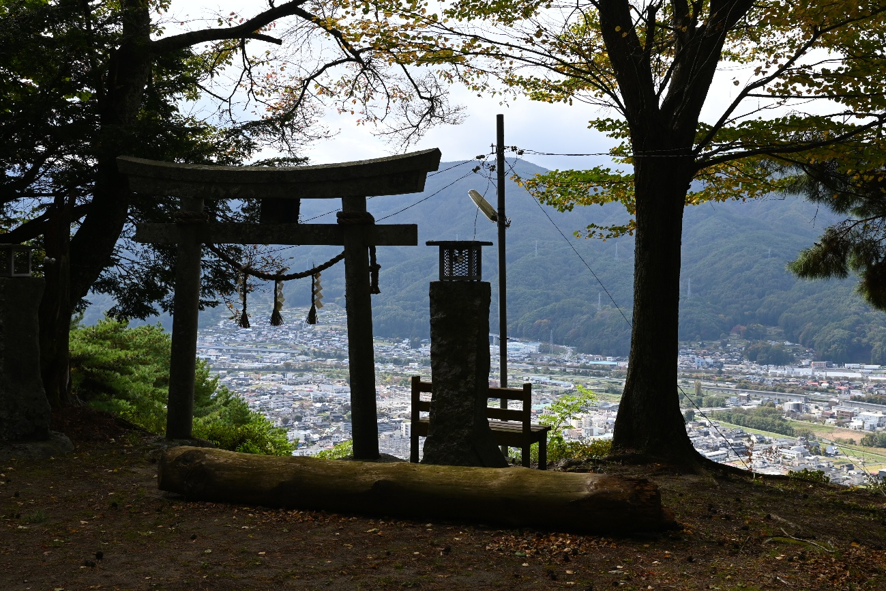
I realized that I had carelessly scheduled golf trips in November, leaving little opportunity to leisurely enjoy the autumn foliage. Although I thought it was still too early, I headed towards Chino with a faint hope that I might be able to enjoy it a little at the higher elevations of Tateshina. From the Yokotani Kannon Observatory, on a clear day, you can see the Southern Alps to the left, Mount Ontake straight ahead, and the Northern Alps, including Mount Hotaka, to the right. The slightly colored mountains at my feet and the town of Chino spread out below were enough of a treat for the eyes. Beyond the gentle mountain on the left (Mount Irikasa) lies Takato Castle, and beyond that, the Ina and Kiso Road.

Whenever I get on the Chuo Expressway and cross the border into Yamanashi Prefecture, I'm always reminded of Jiro Nitta's "Takeda Shingen." This book consists of four volumes: Wind, Forest, Fire, and Mountain, and I remember being engrossed in it for two days when I was in junior high school. Shinshu, which Shingen invaded, was populated by numerous small and medium-sized local clans in each basin, but the maps and illustrations showing the layout of castles included in the book were very helpful in understanding the process of his conquest.

I've also enjoyed reading some of the books written by his son, the mathematician Masahiko Fujiwara.

Shingen banished his father, Nobutora, to Suruga and inherited the headship of the Takeda clan. The following year, he invaded Suwa. He attacked Uehara Castle, the main castle of the Suwa clan, but Suwa Yorishige, the head of the Suwa family, withdrew to Kuwahara Castle, a subsidiary castle located about 2 km north, after being besieged for several days, and soon after surrendered. In this battle, Takato Yoritsugu, a member of the Suwa family who had already been won over by Shingen's stratagems, also joined the invasion, suggesting that the family had already collapsed from within before the battle even began.
It is a typical mountain castle, and part of the main enclosure has been converted into a shrine, but it boasts a prime location overlooking the Suwa Basin. Shingen annexed Suwa into the Takeda territory and appointed his chief retainer, Itagaki Nobukata, as the district magistrate to this castle. For the next forty years, until Nobunaga's invasion, it served as the Takeda's base for managing Suwa.

Suwa Grand Shrine has an Upper Shrine and a Lower Shrine, and the families that serve as priests are the Suwa and Moriya clans for the former and the Kanasashi clan for the latter, and they were originally independent of each other. Among them, the Suwa clan was an extremely rare family that held both the positions of Shinto priest and secular daimyo, but after the Edo period, the families of samurai daimyo and Shinto priests (Ohafuri) were separated. Yoritada, who became a subordinate of Ieyasu after the fall of the Takeda clan and laid the foundation for the Suwa Takashima Domain, was a cousin of Yorishige, and his eldest son, Yorimizu, returned to his former territory as the lord of the Suwa Domain after the Battle of Sekigahara.

After the establishment of the Takashima Domain, Yorimizu founded Raigaku-ji Temple at the foot of Uehara Castle and established a mausoleum there where he and his parents (Yoritada and Rishoin) are buried.

From the time of Yorimizu's son, Tadatsune, the family temple of the feudal lord was moved to Onsenji Temple, located on a hill overlooking Lake Suwa, and both temples are designated as national historical sites.
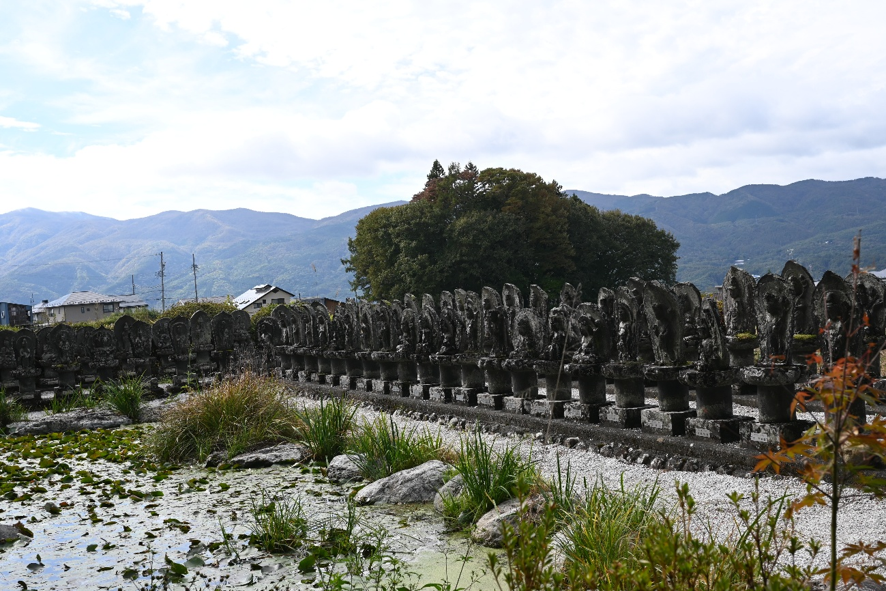
Chino is home to Chōenji Temple, famous for its autumn foliage, but unfortunately, it was too early. The group of 100 stone Buddha statues, built in the late Edo period, is deeply moving, and in tourist photos, the temple's autumn leaves appear to be a particularly vivid red, standing out beautifully alongside the yellow of the fallen ginkgo leaves.

I was disappointed, but the statue of Kannon (Goddess of Mercy) displayed inside the temple cheered me up. I decided to head to the plateau in search of autumn leaves.

The Tateshina Plateau has quite a lot of cultivated land, probably for growing highland vegetables. You can also see some rice paddies. Because the area is built on volcanic ash, the drainage is too good, and the rivers are fast-flowing and quickly disappear, so it seems that securing irrigation water has been a struggle since ancient times. I had the impression that there were many small lakes, but in fact many of them are irrigation ponds that were built before the war. As expected, once we reach an altitude of 1500m, we could see the autumn leaves.

Mishakaike Pond is one such example; a small stream that flows like a valley river is temporarily dammed up, and the water is then released downstream.

Apparently, she was the model for a painting by Higashiyama Kaii, so I recognize her. I can only sigh in awe at the aesthetic sense of a truly first-class painter.

Near the aforementioned Yokotani Kannon Observation Deck stood a small temple. It is said to have been built in 1937 at the request of former Lieutenant General Ichinose Gensuke, who visited the area.

Upon investigation, I discovered he was a former cavalry brigade commander who entered the reserves in 1934. At that time, tanks and other vehicles that had appeared in World War I were replacing cavalry, so that may have been one of the reasons he entered the reserves. I gazed for a while at the statue of this unknown general, wondering if he had been influenced by Akiyama Yoshifuru, given his generation.

From what I can see, he decided to build a temple in the mountains of his hometown when he was 58 years old. I am ashamed of my own laziness and ignorance.


Comments