The Afterglow of the Ouchi Clan: Yamaguchi ~ October 2026 ~

Having heard that the repairs to the five-story pagoda of Rurikoji Temple were completed at the end of last year, I had been looking for an opportunity to visit Yamaguchi City. This town, once known as Nishinokyo, was a refuge for court nobles and culture who fled from Kyoto, which was reduced to ruins during the Onin War, and it was also the seat of government for the Ouchi clan, who held the leading role in East Asian trade, primarily through trade with the Ming Dynasty. Yamaguchi City has many historical sites related to the Mori clan and the end of the Edo period, making it hard to choose where to look, but I decided to focus my tour on the historical sites of the Ouchi clan, which perished nearly 500 years ago. The mother of Haruhide, the younger brother of Otomo Sorin, was the daughter of Ouchi Yoshioki (the 15th head of the Ouchi clan), and he took the name Ouchi Yoshinaga, was sent to Yamaguchi, and became the last head of the clan. He built Konomine Castle on a mountaintop overlooking the town of Yamaguchi as a fortified stronghold (a castle to hold out in times of emergency), but he fled before the Mori army could invade, and escaped to Katsuyama Castle (Shimonoseki City), where he committed suicide, bringing an end to the Ouchi clan. The Yamaguchi Basin, visible from the mountainside, is surrounded by gentle mountains of 200 to 300 meters in height, resembling a miniature garden.

Yamaguchi Prefecture is comprised of the two provinces of Nagato and Suo, and the sites of the provincial capitals are located in Chofu City and Hofu City, respectively. Hofu also has the remains of the provincial government office and a provincial temple that has existed for 1,300 years. The Ouchi clan originated from local officials in Suo and appear in historical documents from the 12th century. The Heian period was a time when private estates (shoen) expanded and provincial government offices decreased. In general, the provincial capitals of Japan became dysfunctional in the 10th and 11th centuries, and the system transformed into one where local officials only held the right to collect taxes. In the Kamakura period, while many Kamakura samurai were stationed as jitō (land stewards) in Kyushu and the Chugoku region to deal with the Jōkyū War and the Mongol invasions, the Ouchi clan is unique in that they rose to prominence as local representatives and became the rulers of several provinces spanning Kyushu.

Nestled in the mountains leading to the Yamaguchi Basin are the ruins of Ryounji Temple, which served as the memorial temple for Ouchi Yoshioki. He held the position of governor of seven provinces and was the only samurai, excluding the shogun and certain members of the Ashikaga family, to reach the rank of Third Rank (Kugyo). His successor, Yoshitaka, committed suicide during a rebellion by Sue Harukata, effectively ending the Ouchi clan. Shortly afterward, this temple was also abandoned, seemingly having existed for only a little over 50 years. The stupas of Yoshioki and his wife are left exposed to the elements, evoking a sense of melancholy.

A magnificent stone wall stands where the main gate once stood, suggesting that it was originally a castle-like structure.

The southeastern part of the Yamaguchi Basin is dotted with place names containing "Ouchi-〇〇," suggesting it was the birthplace of the Ouchi clan. However, the clan originally moved from Tatarahama in Saba District (Hofu City), where the provincial government office was located, at the end of the 12th century, changing their name from Tatara to Ouchi. The area around the confluence of the Fushinogawa and Nihogawa rivers, which flow through the center of the basin, seems to have been their initial base, and many old Ouchi clan temples are located there. Ninpei-ji Temple (now a ruined temple site), which was a Tendai sect temple, was founded during the Ninpei era (1151-1154), and the nearby Hiyoshi Shrine appears to have been established as the temple's guardian shrine, having been invited from Hiyoshi Taisha Shrine on Mount Hiei, which coincides with the time when the Ouchi clan moved their base to this area.

Koryuji Temple was highly valued as a family temple, and it is said that it was founded in 613 by "Prince Rinsho," the founder of the Tatara clan of the Ouchi family, who came from Baekje. On the other hand, it seems that Ouchi Yoshihiro began claiming to be descendants of the King of Baekje in the late 14th century, and the reason behind this was likely his desire to gain a preferential position in trade between Japan and Korea from the King of Korea at the time.

At the nearby Jōfuku-ji Temple, there is a memorial tower for Prince Rinshō, standing alongside the tombstones of Ōuchi Shigehiro and Ōuchi Hiroyoshi. Shigehiro was a head of the family who played an active role in the Mongol invasions, while Hiroyoshi was a head of the family who played an active role in the Nanboku-chō period.

From the time of Hiroyoshi onward (14th-15th centuries), the Ouchi clan moved their base to the present-day Ouchi Clan Residence. Currently, Ryufuku-ji Temple stands on the site of the residence, and there is a memorial tower for Ouchi Yoshitaka, who was cornered by Sue Harukata and committed suicide at Dainei-ji Temple (Chofu clan).

As Yoshitaka's successor, he initially worked to expand the Ouchi clan's power, but after besieging Gassan-Toda Castle in an attempt to attack Amago Haruhisa, he suffered a crushing defeat, and his political influence waned. Mori Motonari's eldest son, Takamoto, had married Yoshitaka's adopted daughter as his principal wife (Terumoto's mother), and they met in this area two years before the Dainei-ji Incident. Thanks in part to this, the Mori clan inherited the Ouchi clan's legacy, and the fact that many temples and shrines related to the Ouchi clan remain, including this temple, is thought to be due to the Mori clan's respect and tolerance for the Ouchi clan. The current main hall is a relocated hall from the aforementioned Koryu-ji Temple, built on the site of the hall that burned down in the Meiji period. It dates back to the Muromachi period and is designated as an Important Cultural Property.

I was once again captivated by the five-story pagoda of Rurikoji Temple. The recent renovation, which involved replacing the cypress bark roofing, apparently took three years, but it looks beautiful, and the balance between the upper and lower levels is just right and very impressive. Originally, this was Koshakuji Temple, built by Ouchi Yoshihiro, but when Mori Terumoto moved that temple to Hagi, Rurikoji Temple, which was located elsewhere, was moved here. Ironically, Rurikoji Temple is the family temple of Sue Hirofusa, three generations before Sue Harukata, who staged a rebellion.
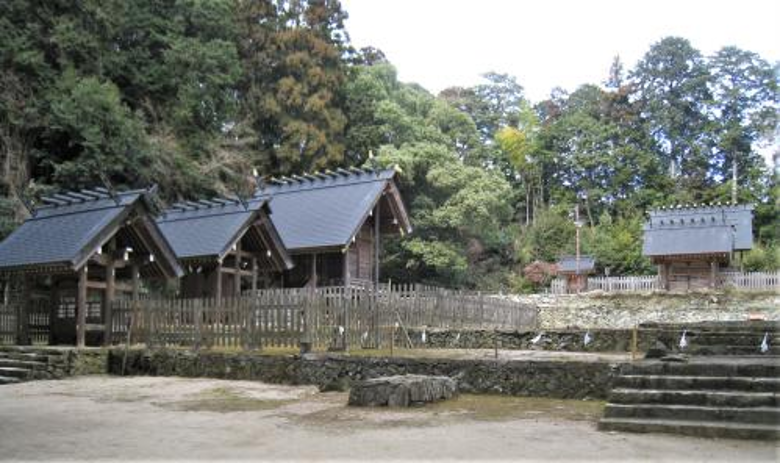
In the 14th century, with the rise of the Ouchi clan and the accumulation of wealth from trade with the Ming Dynasty, the castle town of Yamaguchi underwent development, and several shrines from the Kinai region were invited to reside there. The Furukuma Shrine, which enshrined Kitano Tenjin, as well as the Ima Hachiman Shrine and the Yasaka Shrine, were established, and Yoshioki eventually even invited the Ise Grand Shrine (Yamaguchi Grand Shrine). He accompanied the 10th Shogun Ashikaga Yoshitane to Kyoto and stayed there for 11 years as acting Kanrei (deputy shogun), and it seems that he had the opportunity to visit the Ise Grand Shrine during that time and became convinced of its importance. At that time, the Shikinen Sengu (periodic rebuilding of the shrine) was suspended due to financial difficulties, but I think I would have donated to the Ise Grand Shrine itself. Perhaps he also had the thought of offering temporary refuge to the stable Yamaguchi during a time of war.

Of all the things I saw on this tour, what impressed me even more than the five-story pagoda was the Sesshu Garden at Joei-ji Temple. It was originally the villa of Ouchi Masahiro, who commissioned Sesshu to design the garden during the Bunmei era (1469-1486). I don't have the expertise to judge the merits of gardens, but I cannot help but feel deeply grateful that, in addition to the court nobles who sought refuge from war during the Sengoku period, there was also the ability to understand and invite such first-class cultural figures, which is why Japanese culture has been passed down without interruption.

The memo detailing the history of the construction of Nanmei-tei, the courtyard of the main hall, was fascinating. It seems that when the head priest (Yasuda Tenzan) commissioned Shigemori Mirei to create the garden in 1968, he was perplexed by the request to "create it skillfully, but less skillfully than Sesshu's." I thought, "That's typical of a Zen monk (Rinzai sect, Tofuku-ji branch)," but I imagine that Shigemori, who also had a background as a painter, was the only one capable of creating a garden at a temple with a Sesshu garden, and that this was meant to show the utmost respect.

With the large-scale municipal mergers of the Heisei era, Yamaguchi Prefecture was no exception, and the number of municipalities decreased, making Yamaguchi City considerably larger. If you travel upstream along the Niho River and enter the former Niho Manor area, you will find Genkyu-ji Temple, the family temple of Hirako Shigetsune, who was appointed as the local administrator by Yoritomo. He was a member of the Miura clan and was based in what is now Hirako-go (Isogo Ward, Yokohama City), but moved to this area in 1197, adopted the name Niho, and his descendants subsequently served the Ouchi and Mori clans.

Surprisingly, they had ties to Musashi territory until the 16th century, and there are records of them making donations to temples within their former domain. It can be imagined that even 300 years after being ordered to relocate by Yoritomo, attachment to their ancestral land and pride in their origins were quite important to samurai in the medieval period.

As we venture further into the mountainous region, the river system changes, and the deep mountains of the Saba River basin come into view. This area is the birthplace of Shunjobo Chogen, who worked tirelessly to raise funds for the reconstruction of the Great Buddha Hall, cutting down giant trees and sending them to Nara. This deviates slightly from the theme of the Ouchi clan, but it is a place that is not easily accessible, so I chose it as the last stop on my tour. Along the way, I pass the Izumo Shrine, the second-ranked shrine of Suo Province. The enshrined deities are Okuninushi-no-Mikoto, who ceded the land, and his son Kotoshironushi-no-Mikoto, and it seems to be a typical Izumo Taisha-type shrine, but the explanation states that in ancient times the Izumo people expanded their power and advanced along the Saba River. If we continue downstream, we will pass through Hofu City and reach the Seto Inland Sea. The ancient Izumo Empire was truly impressive.

The burning of Nara by Taira no Shigemori took place in 1180, and Chogen began fundraising in 1186 when he was 60 years old. He then operated from Hofu for the next nine years, and in 1195, the dedication ceremony for the Great Buddha Hall of Todai-ji Temple was held. The imperial court designated Suo Province as a construction fund province, allowing the provincial government's revenue to be used for reconstruction, and the Ouchi clan likely made a significant contribution as local officials. The region that became the source of timber was called Tokuchi, and it is said that the name originated from the fact that it became the territory (land of the Tokubun) of the Kujo family. The end of the Heian period was a time when the Sekkan family split into the Five Sekkan families, and the first to be established were the Kujo family and the Konoe family, with Kanezane being the first head of the Kujo family.

Chōgen received permission from Kanezane to cut down timber within his territory, and used some of it to build the Yakushi-dō (Medicine Buddha Hall) of Getsurinji Temple. The Tōdai-ji Great Buddha Hall, which was built at this temple, was destroyed by fire in 1567 during a battle between Matsunaga Hisahide and the Miyoshi Three, but this Yakushi-dō has been preserved to this day and is said to be the oldest wooden building in the prefecture. Incidentally, the Great Buddha Hall was not rebuilt until 1709, and the Great Buddha was exposed to the elements for 142 years.
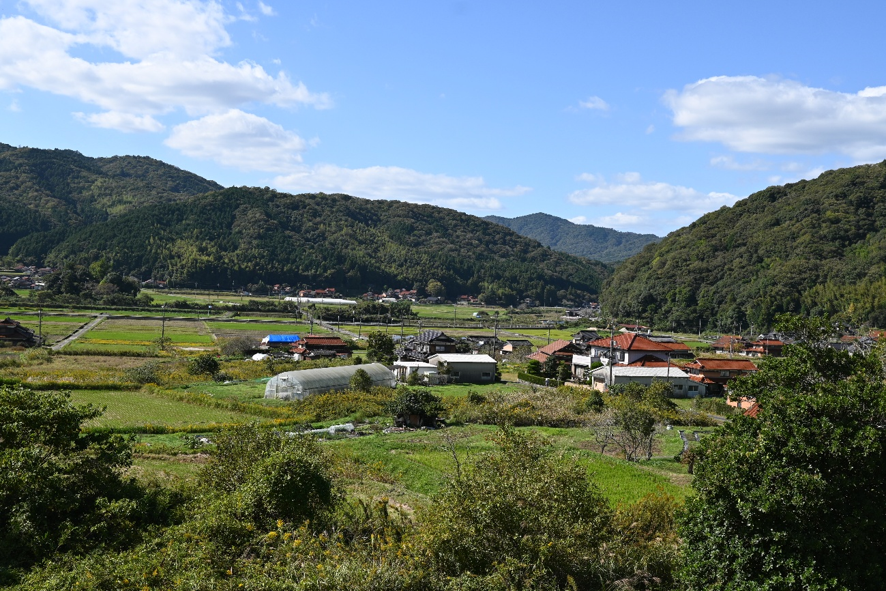
I was able to visit the former estate of the Kujo family in an unexpected place. Not only the Kujo family, but many of the estates owned by the imperial court, temples and shrines, and nobles were encroached upon by local samurai families during the Kamakura and Muromachi periods. The Kujo family, in particular, faced severe financial difficulties, and in 1496, a murder occurred due to a financial dispute. The head of the family, Kujo Masamoto, had a disagreement with his steward (a court noble who managed all aspects of the Kujo family's affairs) Karahashi Arikazu over financial collapse issues and killed him, for which he was punished. This happened 300 years after Kanemitsu helped rebuild the Great Buddha Hall, but somehow the Kujo family managed to survive the Sengoku period and maintain their status from the Edo period onward. It's worrying in these times, but the temple and surrounding countryside, which are still over 800 years old, somehow remain.

The Ouchi clan imported a large quantity of Goryeo-era Buddhist scriptures (woodblock prints) through trade with the Joseon Dynasty of Korea. Goryeo, which had Buddhism as its state religion, was overthrown in 1368 by a coup led by Yi Seong-gye. The Joseon Dynasty's shift in religious policy (anti-Buddhist policy), which involved the consolidation of temples and the confiscation of temple lands, likely accelerated the transfer of scriptures and Buddhist statues to Japan. Traditionally, Buddhist scriptures were transmitted primarily through handwritten copies, some of which were inaccurate. However, scriptures compiled during the Goryeo period were academically scrutinized and corrected, making them highly valued. Japan's cultural continuity spanning at least 1500 years and the legacy that remains today are thanks in part to the unbroken imperial line, but the Ouchi clan played a crucial role in understanding the value of these traditions during a period of war in the Middle Ages and in playing a part in cultural preservation amidst a time of conflict. Finally, I visited the stone thirteen-story pagoda of Hokoji Temple and headed to Hiroshima City for golf the next day. It is said that Chogen transcribed the Great Prajnaparamita Sutra and buried it beneath the pagoda.


Comments