From Mount Akagi to Maebashi - DEC, 2025 -

I started this year's historical walk with a visit to Takasaki's ancient tombs, but before I knew it, the end of the year was upon us, and I had been planning to explore the ancient tombs on the opposite bank of the Tone River. Gunma Prefecture is lined from west to east with the famous mountains of Myogi, Haruna, and Akagi. The Tone River, which flows between Haruna and Akagi, splits vertically and gradually flows eastward as it enters Maebashi city. Akagi Shrine, esteemed as a Grand Shrine of Honor in the Engishiki, consists of three shrines lined vertically from near Mount Akagi's summit to the southern lowlands. My first stop was Ohora Akagi Shrine, located on the shore of Lake Onuma (a caldera lake). Lake Onuma is 1,400 meters above sea level, and while it's a summer resort, it was surprisingly deserted, with the temperature at 5 degrees.

The current shrine building was rebuilt and relocated in 1968, but the old shrine grounds, located a few hundred meters away, remain as they were. The shrine building, built in 1642 by the Tairo (Lord of Maebashi Domain), Tadakiyo Sakai, had deteriorated, and rebuilding it had been an issue since the Meiji period.

At the current site (Kotorigashima) there is a pagoda from the Muromachi period, and mirrors and sutra tubes from the Heian to Muromachi periods have been found underground. It is clear that this has been a place of worship since ancient times, and although it is a beautiful place, it is amazing that it was carved out of this high mountain area.

It is said that Kunisada Chuji hid here for a while.

The surrounding vegetation was birch forest, but there were apparently bears around, so we decided to quickly descend the mountain.

The autumn leaves at Miyano Akagi Shrine on the mountainside were at their peak. The water basin is surrounded by a pond with koi swimming in it.

As you descend to the third Ninomiya Akagi Shrine, the ground becomes fairly flat. Both Akagi Shrines are dedicated to Akagi-no-kami, Mount Akagi's deity, as well as Toyokiirihiko-no-mikoto (the son of Emperor Sujin and the ancestor of the Kamitsukeno clan), and Oonamuchi-no-mikoto (also known as Okuninushi-no-mikoto). It's exciting to imagine the connection to the nearby Asakura and Hirose burial mounds.

This group of burial mounds is enormous, built along the river terrace plateau of the Hirose River (formerly the Tone River), and a survey conducted in 1935 found 154 mounds. Unfortunately, many of them were destroyed in the postwar residential development of Maebashi City. The highlight of this visit is the Hachimanyama Tomb, the largest front and rear square tomb in eastern Japan (mound length 130 meters), dating from the early 4th century. Front and rear square tombs are mysterious mounds that appeared in the 4th century but disappeared later in the same century as they were overtaken by keyhole-shaped tombs, and this is the only one of these tombs in the group.

300m down the Hirose River from here was the keyhole-shaped tumulus "Tenjinyama Kofun" (129m long), but since its investigation in 1968, more than half of it has been destroyed by residential development and lost its original shape. It is believed to belong to a person who succeeded the chieftain buried in the above-mentioned Hachimanyama Kofun and became a subordinate of the Yamato royal authority (mid-4th century). Bronze mirrors and iron weapons have been excavated and are now stored at the Tokyo National Museum, so I plan to go to Ueno to check them out soon.

The Tenkawa Futagoyama Kofun is a 6th century keyhole-shaped tumulus that has been preserved as a park in a residential area. Later, under the Ritsuryo system, the provincial capital of Kozuke Province was located in the Soja area on the west bank of the Tone River.

The Ogo clan was a powerful clan that wielded power at the foot of Mount Akagi in the Middle Ages. They are said to be a branch of the Ashikaga clan (not the Minamoto clan), descendants of Fujiwara no Hidesato, and their name appears in the Tale of Heiji. Chozenji Temple has a tombstone for Ogo Taro, who is said to have founded the temple, and as it bears an inscription from the third year of the Jowa era (1347), it is believed to have been founded before that. During the Sengoku period, the Ogo clan came under the control of Hojo Ujiyasu and was given territory in Ushigome (near present-day Shinjuku), and later served the Tokugawa clan as hatamoto until the end of the Edo period.

Nearby is Ogo Castle, and Mount Akagi can be seen from the remains of the main citadel. After the Odawara Campaign, Makino Yasunari, who served Ieyasu, became the lord of the castle, but the Makino family later moved to Nagaoka, and the Ogo domain was transferred to the Maebashi Domain, and the castle was abandoned.

During the first half of the Edo period, the Sakai family was granted the Maebashi domain with a fief of 150,000 koku. The Sakai family was originally a branch of the Matsudaira clan, and in the second half of the 15th century split into two families (the Gagaku no Kami line and the Saemon no Jo line). During the Edo period, the former two families (the lords of Maebashi and Obama domains) and the latter family (the lord of Shonai domain) became fudai daimyo with fiefs of over 100,000 koku, meaning that there were three families capable of producing "tairo" (chief councilors). The Maebashi domain's lord family had Ryukai-in Temple, founded by Ieyasu's grandfather, Kiyoyasu, as their family temple, and moved whenever their post was changed, but after they were transferred from Maebashi to Himeji, they left their fief, including the cemetery, in its current location.

I've been to quite a few feudal lord graveyards around the country, but the Sakai family graveyard, which was the pillar of the feudal domain system, was truly impressive, with the graves of all 15 feudal lords and two branch feudal lords from the Edo period lined up in neat rows. Of particular note was the fourth feudal lord, Sakai Tadakiyo, who built the aforementioned Akagi Shrine. He wielded great power as Tairo (chief advisor) during the latter half of the reign of Shogun Ietsuna, but was ousted when Tsunayoshi became Shogun.

One of the reasons for the bad relationship between Tsunayoshi and Tadakiyo is that after Ietsuna's death, Tadakiyo tried to appoint Imperial Prince Arisugawa Yukihito as the next Shogun in order to prevent Ietsuna's younger brother Tsunayoshi from being appointed Shogun, but was opposed by the Mito Komon-sama and gave up. After the assassination of Minamoto no Sanetomo, Hojo Yoshitoki asked Emperor Go-Toba to send his son to Kamakura as Shogun, which is somewhat similar. I was surprised to see a stone pillar in front of the gate commemorating the Arisugawa-no-miya prayer hall.

While the exact location and scale of the provincial capitals and provincial temples in the Soja region are still under investigation, the remains of the massive Hakuho Temple were excavated in 1910 and dubbed the "Sanno Abandoned Temple." The discovery of the central stone of a five-story pagoda and a large stone ridge ornament for the roof provide insight into the temple's scale and prestige. The "Yamanoue Monument" (681, the 10th year of Emperor Tenmu's reign), one of the three monuments in Kozuke registered in the UNESCO Memory of the World Register, records that a monk from Hokoji Temple (Nagatoshi) erected the monument, confirming that the name of the Sanno Abandoned Temple was Hokoji. The deity enshrined at Akagi Shrine (Toyokiirihiko no Mikoto), the Kamitsune clan, the burial mounds dating back to the 4th century, and the continuity of the ancient Kozuke region, including the provincial capitals and temples of Soja, are becoming apparent.

Akimoto Yasutomo, who fought in the Battle of Sekigahara, received land in Soja from Ieyasu and built Koganji Temple as his family temple, but the Akimoto family has placed the gravestones of successive feudal lords on top of the adjacent ancient tomb (Hotoyama Tomb).
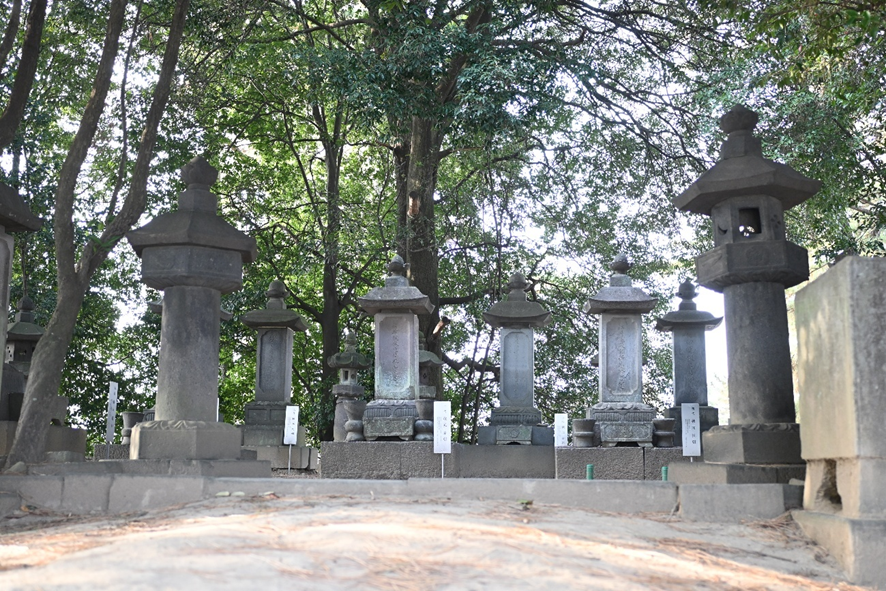
The top of the small square mound has been flattened and the gravestones are lined up on a narrow plot of land, giving it a cramped impression compared to that of the Sakai family. This family had a stipend of 10,000 koku in Soja, but after a series of transfers, they produced a senior councilor (Akimoto Takatomo), and by the end of the Edo period, they had risen to become a feudal lord of the Tatebayashi domain with a stipend of 60,000 koku. They governed Soja well and enjoyed strong support from the people, and although the Akimoto family later moved from Kai Tanimura to Musashi Kawagoe to Dewa Yamagata to Ueno Tatebayashi, they left their family temple and grave in place, and maintained good relations with the local community.

The Soja Disturbance, which occurred in 1709 (the 6th year of the Hoei era), was an incident in which farmers of Soja, unable to tolerate the harsh rule of the hatamoto Ando Nobutomi, filed a lawsuit. They also appealed to the then senior councilor Akimoto Takatomo, essentially telling on their former lord, but thanks to Takatomo's help, the farmers won the case. The Akimoto family left Soja in 1622 (the 8th year of the Genna era), and 87 years had passed, but it seems their attachment to their former territory remained unchanged.

The nearby Soja Kofun Group was built later than the Asakura and Hirose Kofun Group, dating back to the end of the 5th century, but the area developed as a political center where provincial capitals and temples were located. After the construction of the Soja Futagoyama Kofun, the largest of the group, in the late 6th century, as was the case throughout the country, construction of keyhole-shaped tombs came to a halt in favor of smaller square tombs, which began to incorporate stone chambers.

Speaking of Maebashi, there is Maebashi Castle, where Uesugi Kenshin also passed through. Its original name was Umabashi Castle, but it is a big theme with many interesting stories, so I will touch on it on another occasion.


Comments