Scurrying Around Aizu ~AUG, 2026~

I've had many opportunities to visit Aizu on business trips in recent years. With limited time, I've only managed to admire the beautiful stone walls of Tsuruga Castle, so this time I decided to take a tour of the Aizu Basin. I didn't go to Tsuruga Castle itself, but I did view the castle from the site on Iimoriyama where the Byakkotai committed suicide.

Among Niigata Prefecture's major rivers, the Agano River (known as the Aga River in Fukushima Prefecture) flows from the mountains surrounding Aizu, irrigating a wide basin before crossing the Niigata prefectural border, thus guaranteeing Aizu's fertility. One of its headwaters is Lake Inawashiro, and in the Meiji era, the Asaka Canal was constructed from the lake to the Asaka area (Koriyama region), which receives less rainfall, dramatically increasing agricultural production. Yonezawa and Yamagata also benefited from abundant water resources (the Mogami River), and it was from these rich basins that powerful Sengoku-era daimyo such as the Mogami, Date, and Ashina clans emerged.

The Kojiki refers to this area as "Aizu," and it appears in the account of the Four Generals, to whom Emperor Sujin dispatched members of the imperial family to the four directions of the country. It is the point where Ōhiko-no-mikoto, who advanced eastward along the Hokuriku Road, and Takenunakawawake-no-mikoto, who traveled eastward along the Tōkaidō Road, met, and the Isasumi Shrine, which enshrines both generals as its main deities, is located there. The former was Emperor Sujin's uncle, and the latter was his son and cousin, and this suggests that Aizu came under the influence of the Yamato Kingdom as part of the unification efforts of the 3rd and 4th centuries.

The temple grounds are adorned with numerous wind chimes. The main shrine building was destroyed in a fire in 2008 and is currently under reconstruction. I sincerely hope for its speedy recovery.

The Otsukayama Kofun on the eastern bank of the basin was built in the latter half of the 4th century, but the Raijinyama Kofun in Natori City, Miyagi Prefecture, built at the end of the 4th century, is the largest keyhole-shaped burial mound in the Tohoku region. It is thought that the line connecting Aizu and southern Miyagi Prefecture was the northern limit of the Yamato Kingdom in the 4th and 5th centuries, and indeed, a triangular-rimmed bronze mirror with divine beast motifs, which was distributed by the Yamato Kingdom as a token of submission, has been found at the Otsukayama Kofun.

The Records of Wei states that Himiko received 100 mirrors from Wei, but currently, more than 500 mirrors have been found in Japan, and there seem to be around 150 different designs. It appears that many of them were mass-produced using molds made in Japan. As an artifact found in ancient tombs, it's a hot topic, and I'm looking forward to seeing what facts will be revealed in the future.

Tokuichi is a mysterious figure, but he was a Buddhist monk of the Hossō sect who was active from the Nara period to the early Heian period. He is known for his Buddhist doctrinal debate with Saichō, known as the San'ichi Gonjitsu Sōron. He built many temples from the Kanto to Tohoku regions, and in Aizu, he constructed a hall that enshrines five Yakushi Nyorai statues.

In the Aizu Basin, temples such as Enichiji, Unai Yakushi, Nodera Yakushi (formerly Jikoji), and Kitayama Urushi Yakushi were located to the east, west, north, and south, respectively, with Shojoji Temple built in the center. Currently, with the exception of Shojoji and Enichiji (which was once abolished during the anti-Buddhist movement), three of the temples are in ruins, with only the Yakushi Hall remaining. I was able to visit the western and southern temples, but the stairs leading up to the entrance of Kitayama Urushi Yakushi had collapsed due to a landslide and it had not been maintained for a long time. While the halls of abandoned temples are often maintained by local volunteers, it pains me to occasionally encounter such decaying temples and shrines when traveling around the country.

Another temple I was interested in was Enzoji Temple in Yanaiizu, slightly west of the Aizu Basin. This temple is also said to have been founded by Tokuichi, who brought in a statue of Kokuzo Bodhisattva carved by Kukai. The temple, built on white tuff, makes a picturesque scene together with the gorge of the Agano River flowing below.

I saw a sign warning of bears, so I walked along ringing my bell. I carry my shrine and temple stamp books separately, so there was no problem, but the head priest said he wouldn't write in the same book for both shrines and temples. I wasn't particularly surprised, as some places are strict and won't give a stamp unless you offer sutras, but I did wonder if there was some reason for this strictness, given that Japan is originally a country where Shinto and Buddhism are syncretized (lol). I personally enjoy experiencing history and visit temples and shrines without any particular preference, and I take the stance of only asking for stamps if it's not too much trouble.

Shōjōji Temple was once a large temple complex, but the remaining Yakushi-dō (Medicine Buddha Hall), rebuilt during the Muromachi period, is designated as an Important Cultural Property. However, what is truly remarkable about this temple is the large number of Heian period Buddhist statues it houses, and it is particularly noteworthy that it has 12 statues from the 9th century (3 National Treasures and 9 Important Cultural Properties). It is extremely rare to find such a collection of valuable Buddhist statues outside of Kyoto and Nara. Among them, the Kōmokuten (Important Cultural Property) is apparently on loan to the National Museum, and I plan to go see it soon. Reservations are required to view the statues, so I've made it a task for my next visit, along with visiting the ancient Enichiji Temple ruins.

The Sengoku period in Aizu was centered around the Ashina clan, but originally they were descendants of Sawara Yoshitsura, the son of Miura Yoshiaki, who died fighting at Kinugasa Castle in response to Yoritomo's uprising. They were granted the land of Aizu for their military achievements in the Oshu War. The name Ashina originates from a place name on the Miura Peninsula, and the place name still remains on the western coast of the peninsula today (two years ago I toured the Miura Peninsula and visited historical sites of the Miura clan). After being defeated in the Hoji War in the mid-Kamakura period, the Miura clan split into two groups: one remained on the peninsula and the other migrated to Aizu, but they were both driven out by Hojo Soun and Date Masamune, respectively.

During Hideyoshi's pacification of Oshu, Date Masamune was transferred to the former territories of the Osaki and Kasai clans, and Gamo Ujisato took over Aizu. The Gamo clan were originally retainers of the Rokkaku clan in southern Omi, but Ujisato followed Nobunaga and became his son-in-law. Later, he pledged allegiance to Hideyoshi, contributed to the unification of Japan, and rose to the position of lord of Aizu with a domain of 920,000 koku. Even if the Toyotomi family's rule wavered, he was undoubtedly trusted as a person who could repel invasions by the Mogami and Date clans and keep the Tokugawa family in check from behind. Regrettably, his son Hideyuki's abilities did not match his father's, and in his later years, Hideyoshi roughly doubled his territory and placed Uesugi Kagekatsu in Aizu. At Kōtoku-ji Temple, there is a five-tiered pagoda containing Ujisato's hair (his body is buried at Ōbai-in Temple in Daitoku-ji Temple in Kyoto).

This temple is an ancient temple founded by the Ashina clan during the Kamakura period, but Hideyoshi used it as a base to issue orders for the pacification of Oshu. It was from here that he took Yonezawa and Aizu from Date Masamune and ordered him to relocate, made personnel decisions for Gamo Ujisato, and issued the Taiko land survey. The tombs of the Aizu domain's leading figures were interesting, and I made many discoveries, but the most interesting of all was the tombstone of Ryūzōji Sueaki (Hakuan). He was the illegitimate son of Ryūzōji Takafusa, who committed suicide when the Saga domain was officially and effectively transferred to the Nabeshima family under the Tokugawa regime, and even during the time of Iemitsu, he repeatedly advocated for the restoration of the Ryūzōji clan. Iemitsu probably found him troublesome, so he entrusted him to his half-brother Hoshina Masayuki, and the family subsequently served as Aizu domain samurai (300 koku) until the Meiji Restoration.

In his later years, Hideyoshi decided to place Uesugi Kagekatsu in Aizu as a general who could replace Ujisato, and granted Kagekatsu a territory of 1.2 million koku, which included the Shonai region in addition to the existing Aizu territory. The existing Tsuruga Castle was located on the eastern side of the Aizu Basin and had become somewhat cramped, so Kagekatsu began construction of Kozashi Castle in the center of the basin. As a flatland castle of the same period, it was roughly the same size as Mori Terumoto's Hiroshima Castle and twice the size of Tsuruga Castle (Aizu-Wakamatsu Castle), but unfortunately it could not be completed by the Battle of Sekigahara. Part of the castle walls remain as a park, and the combination of Mount Bandai and the vast rural landscape is deeply moving.

After the Battle of Sekigahara, as peace prevailed, Aizu's strategic importance gradually changed. Following the return of the Gamo family and the rule of the Kato Yoshiaki and Akinari father and son, Hoshina Masayuki was granted a fief of 230,000 koku. He was an illegitimate son of Hidetada, who, fearing the jealousy of his wife (O-Go), could not acknowledge him and entrusted him to the Hoshina family. Out of gratitude to his adoptive family, he used the name Hoshina throughout his life, and it was not until the third lord, Masataka, that the family adopted the name Aizu Matsudaira. He left instructions for his descendants to strictly adhere to loyalty to the Tokugawa shogunate and samurai ethics, and the domain's discipline is thought to have been among the strictest in Japan. Perhaps this is what created the conditions for fierce resistance and tragedy during the Boshin War. Iimoriyama is a small hill about 300m high, but the place where the Byakkotai committed suicide was a scenic spot on the mountainside about 100m high. They saw flames from the keep of Tsuruga Castle, less than 3km away, and mistakenly believed that the castle had fallen. In reality, it lasted for another month.
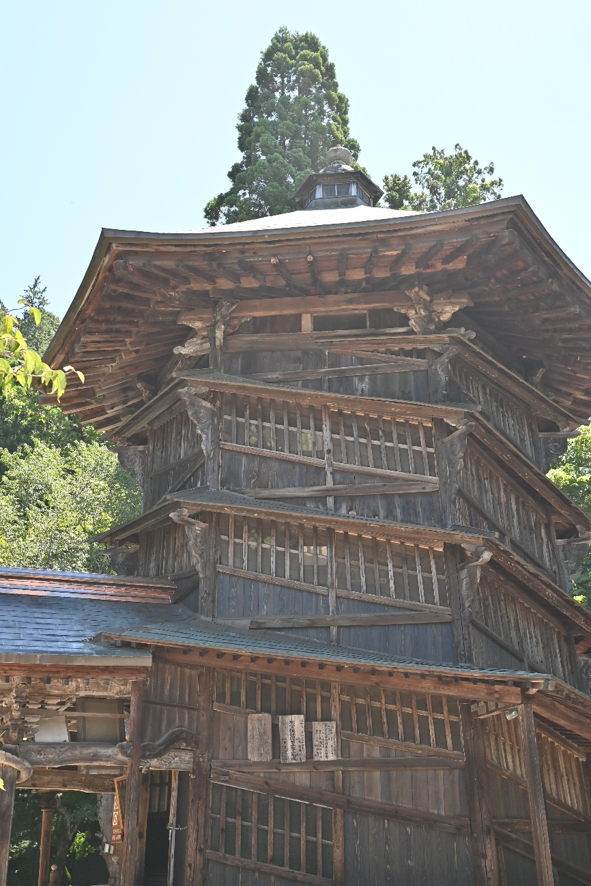
On Iimoriyama Mountain is the "Sazaedo" (spiral hall) of the former Shoshoji Temple, built during the Kansei era. It's a remarkable structure where you can ascend and descend two slopes, one going up and one down, to pay your respects to the 33 Kannon statues. It's a humorous building, but it's complex and looks like it would be difficult to maintain, so I hope it will be carefully preserved for future generations.

During the siege of Tsuruga Castle, the bodies of 19 Byakkotai members, left exposed to the elements, were temporarily buried at the nearby Myokoku-ji Temple.

Lord Matsudaira Katamori and his son remained under house arrest here for about a month after the castle surrendered, awaiting a decision from the new government.

The Aizu domain ultimately received the harshest punishment among the Ouetsu Reppan Alliance, being transferred to the Tonami domain with a 30,000 koku stipend at the tip of the Shimokita Peninsula. Its actual yield was apparently only 7,000 koku, and life there was extremely harsh. Despite being branded an enemy of the court, the domain produced many great figures who sought to restore their honor. It's been 13 years since the original broadcast of "Yae no Sakura," which is being rebroadcast on BS this year. Haruka Ayase's popularity remains immense.

Kayano Nagaharu, the chief retainer, took full responsibility for the Aizu War, pleaded for his lord's life to be spared, and committed suicide. He was buried in the family cemetery at Tennei-ji Temple. In front of it is a slightly newer grave inscribed with the name Kori Nagamasa, who was Nagaharu's second son and committed suicide while studying at the Kokura Domain's school. According to legend, the reason for his suicide was that he sent a letter to his mother back home complaining about the food, received a reprimanding reply from her, and then dropped the letter, which was seen by his colleagues.

The "Jū no Okite" (Ten Commandments) for the sons of the Aizu clan still resonates deeply today. While it may not be something that would lead to suicide by modern standards, the strict discipline and the habit of taking responsibility that children were taught from a young age are reminiscent of noblesse oblige, and I believe it has value to be incorporated into modern school education.

This time, I got off the highway at Shirakawa and entered Aizu via local roads. Of the five main roads leading into Aizu, the Shimotsuke Road connects Imaichi, just before Nikko, with the castle town of Aizu. Heading south through the Aizu Basin and entering the Minami-Aizu area, you cross the Hidama Pass and arrive at Ouchi-juku. It is now a tourist spot lined with inns and souvenir shops, but it seems that the Edo-period post town has been preserved as it was. Toyotomi Hideyoshi, Hoshina Masayuki, Yoshida Shoin, and Isabella Bird all stopped here. The Aizu domain had a territory of 230,000 koku, but separately, the 50,000 koku of Minami-Aizu, centered around Tajima, was shogunate territory, and the Aizu domain was entrusted with the collection of its taxes.

Masayuki Hoshina was the one who thoroughly developed the highway, and it is said that he and the second lord of the domain, Masatsune, traveled back and forth along it more than 20 times for the sankin-kōtai (alternate attendance) system. The highway from that time has been recreated near the Hidama Pass.

And so, I was busy again this time, but I stayed at a traditional Japanese inn in the city with the aim of enjoying Aizu's local cuisine (and sake). Everything was delicious without exception, but the "pea rice in a wooden box" that I had for breakfast was especially exceptional. It was far too much to eat in the morning, so I made the leftovers into rice balls and enjoyed them for lunch as well. Fortunately, it is impossible to fully understand Aizu in just one visit, so I will definitely come back again.


Comments