Shoyo Nishiyama ~ Kyoto, May 2026 ~

This time, I decided to stroll along the west side of the Katsura River and made a reservation for Saihoji Temple (Moss Temple), a place I've wanted to visit for many years. A large weather front was approaching, so I looked for a place with a good view while the weather was still clear, and it seemed that Yoshiminedera Temple was the best. In Higashiyama, the view from Shogunzuka Kofun was the best, but from here, you can see the Kyoto Basin in the opposite direction, with the ridgeline of Mount Hiei stretching out in front of you.

Emperor Kanmu temporarily constructed Nagaoka-kyo, located before the Katsura River, while moving the capital from Heijo-kyo to Heian-kyo. Temples and shrines built during the relocation of the capital to Nagaoka-kyo still remain around Nishiyama, and because the area was previously a colony of the Hata clan, who were of foreign origin, many legends and origins are intertwined.
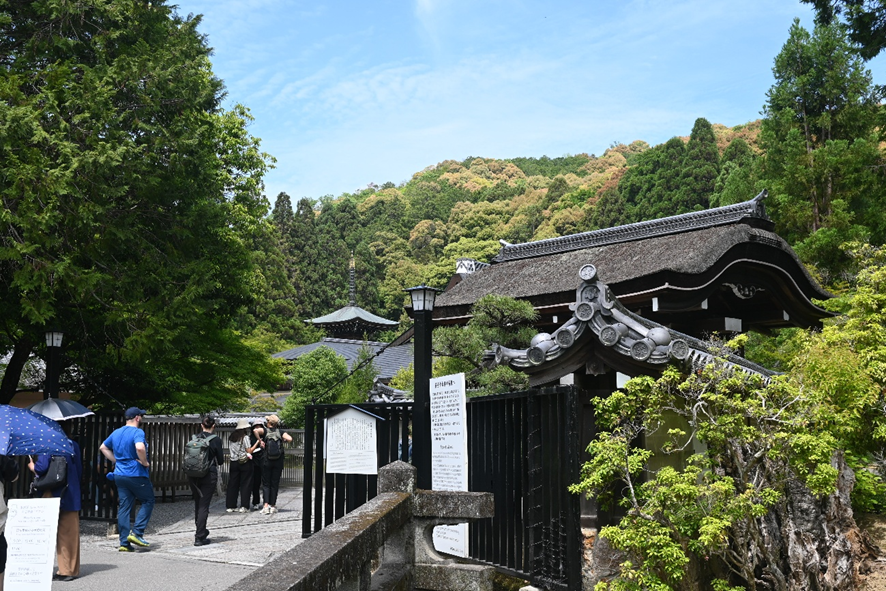
The origins of Saihoji Temple are said to date back to the site of Prince Shotoku's villa. Across the Katsura River, at the entrance to Sagano, lies Uzumasa, named after the Hata clan. There are also Koryuji Temple, founded by Prince Shotoku, and the Hebizuka Kofun (ancient burial mound), suggesting that the area from Sagano to Nishiyama was under the control of the Hata clan.

Since the 1970s, visits to the temple have been by reservation only, and previously, reservations were made by postcard, making it difficult to access and giving me the opportunity to visit. Recently, online reservations have become available, and I was so happy that I became a Saihokai, an annual support member, even though there is no guarantee of how many times I will be able to visit. The moss that spreads beautifully throughout the vast strolling garden is wonderful, but it seems that the reason the moss spread so much is because the nearby Saihoji River, which flows into the Katsura River, has flooded many times in the first place.

I now understand why Ashikaga Yoshimitsu practiced Zen meditation here, why Iwakura Tomomi lived in seclusion during the late Edo period, and why Steve Jobs frequented this place. They even offer a service where you can transcribe a passage from the Kannon Sutra and receive it as a souvenir, making me ashamed of my previous hesitation due to its perceived intimidating nature. Stay hungry, stay foolish!

The temples in Nishiyama are all at their peak during the autumn foliage season, and walking through the temple grounds, you can imagine how beautiful the trees must be in the fall. There is a hiking trail to Konzo-ji Temple, and I encountered several groups of hikers, many of whom were elderly and in good physical condition. Although there is a parking lot in front of the temple gate, the mountain path is narrow and steep, and the taxi driver was being very careful.

Jūrin-ji Temple is said to be the temple where Ariwara no Narihira lived in seclusion. Narihira was the grandson of Emperor Heizei and Emperor Kanmu, and was originally a legitimate member of the imperial family, a thoroughbred. However, his grandfather, the retired Emperor Heizei, lost a political struggle with Emperor Saga and was involved in the Kusuko Incident, so his career as a court official was not successful. On the other hand, he was a talented poet and was selected as one of the Six Poetic Geniuses and one of the poets in the Hyakunin Isshu (One Hundred Poets, One Poem Each). He was also famous as a rare playboy and is said to be the protagonist of the Tales of Ise.

There was a small Hōkyōintō pagoda here, said to be Ariwara no Narihira's tomb, but the pagoda was built after the medieval period, so it doesn't fit the timeline. There is also a legend that Fujiwara no Takako (Empress Dowager of Emperor Seiwa), who was once Narihira's lover, visited the nearby Ōharano Shrine and was guided to his location by the smoke rising from a salt kiln made with seawater from Osaka Bay. I was impressed to actually see the salt kiln, but after reading the explanation carefully, I learned that it was built in recent years. Legend aside, the story of the descendants of Emperor Heizei, who resisted the relocation of the capital, living in seclusion in the mountains near the ruined capital (Nagaoka-kyō, Heijō-kyō) is deeply moving.

I've come to Yoshiminedera Temple, a popular temple in the autumn-colored Nishiyama area that attracts many visitors. It boasts the largest temple complex and grounds in the vicinity, and it too has received extensive restoration and construction from Keishoin (the real mother of Tokugawa Tsunayoshi). She provided assistance to shrines and temples throughout the country, but this was a temple she particularly focused on. With buildings extending all the way up the mountain, the aforementioned spectacular view unfolds from the Yakushido Hall at the summit, making it a place well worth the uphill climb.

Near Koke-dera Temple, there are several other charming temples with a unique character. Jizo-in Temple is also known as Take-dera Temple (Bamboo Temple). These days, the bamboo grove path at Tenryu-ji Temple on the opposite bank of the Katsura River is so crowded that it's difficult to move around, so this is a hidden gem.

This is the family temple of Hosokawa Yoriyuki, who served as Kanrei (deputy shogun) during the early days of the Ashikaga shogunate. The Hosokawa family, a branch of the Ashikaga clan, ruled the country as Kanrei throughout the Muromachi period, and became a powerful force in the Kinai region during the Sengoku period, using Shikoku and Izumi as their supply base. However, they were eventually replaced by the Miyoshi clan, who served as shugodai (deputy governors). Yoriyuki's tomb, made of natural stone, is embraced by the roots of an ancient tree, and a tree planted by former Prime Minister Hosokawa Morihiro is located behind it. The Hosokawa family that became the lords of the Kumamoto domain was a considerably collateral branch, but in 600 years, no other family has produced prime ministers in each era.

There is also a legend that this is the place where Ikkyu Sojun, who is said to be the illegitimate son of Emperor Go-Komatsu, was raised. Ikkyu entered Ankoku-ji Temple and became a monk at the age of six, but it is said that he was raised here until then.

Kegonji Temple (also known as Suzumushi-dera Temple), which is frequently mentioned on social media, is located in this area and keeps thousands of crickets year-round. Although it was May, Kyoto city was hot and humid with temperatures easily exceeding 30 degrees Celsius, but the temple was equipped with air conditioning for the crickets, making the interior comfortable. The 30-minute Dharma talk was delivered with practiced ease and was enjoyable to listen to. I felt that with the recent decline of the danka system (parishioner system), opportunities to hear the teachings of Buddha have decreased, and this would be a particularly good experience for young people. The rebuilding of the main hall requires a huge expense, including reinforcing the hillside behind the temple, so I made a small contribution to help.

Shōji-ji Temple is also known as the Temple of Flowers, but it is famous as the temple where Saigyo (Sato Yoshikiyo) became a monk.

He was roughly the same age as Taira no Kiyomori and served as a samurai of the Northern Guard under Emperor Toba, but he became a monk at the age of 23. The reason for his renunciation of the world is a mystery, but one theory is that it was due to his unrequited love for Taikenmon-in Shōshi, the Empress of Emperor Toba. This theory was adopted and dramatized in the 2012 Taiga drama "Taira no Kiyomori." Fujiki Naohito played the role of Saigyo, and Dan Rei played the role of Shōshi.
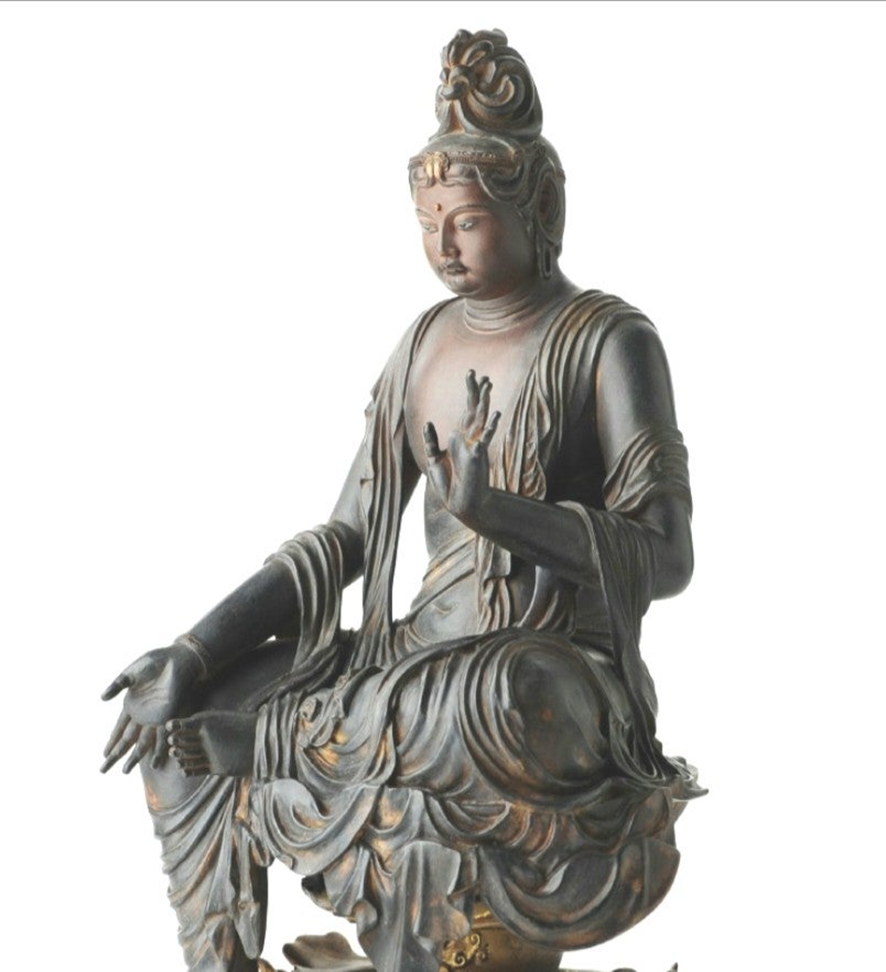
The adjacent Gantoku-ji Temple houses the national treasure "Nyoirin Kannon," which can be viewed for a 500 yen entrance fee. While its founding dates back to the late 7th century, it has fallen into disrepair in recent years, and its principal image was entrusted to Shoji-ji Temple. The early Heian period Buddha statue is strikingly handsome and imposing, reminiscent of the Fugen Bodhisattva at Toji Temple with its eyes wide open. It was an unexpected encounter with a national treasure Buddha.

Oharano Shrine is a shrine of the Fujiwara clan that was established when the capital was moved to Nagaoka-kyo, with the deity invited from Kasuga Taisha Shrine. In The Tale of Genji, Murasaki Shikibu depicts the reunion of Emperor Reizei (whose real father was Hikaru Genji) who visits the shrine, and Tamakazura and her real father, Tō no Chūjō, who are observing the visit.

Fujinokawa from the Ise-no-umi stable, a local resident, made it to the top division in last year's summer tournament. At 123kg, he's quite small by modern sumo standards, but he's tenacious and performs admirably. This shrine has a tradition of Shinto sumo wrestling that spans over 300 years, and he likely grew up there. He's only 21, so we're excited to see what the future holds for him.

Shōhōji Temple is known as the "Temple of Stone" because of the many large stones gathered there. Founded by a disciple of Ganjin, its history dates back to the Nara period. Unlike the war-torn central part of Kyoto and Higashiyama, the temples and shrines of Nishiyama seem to have stood quietly since the time of the Hata clan, maintaining a good distance from Kyoto. While not flashy, the passage of time is palpable, creating a peaceful and tranquil space.

Matsuo Taisha Shrine was built in 701 AD as the guardian shrine of the Hata clan, but it seems that before that, it was worshipped as a sacred rock on Mount Matsuo. The Kame-no-i well within the shrine grounds has been famous for its pure water since ancient times, and it is said that sake brewed with this water never spoils.

This shrine is now considered the god of sake brewing, and as a sake drinker, I felt I had to pay my respects at least once. The theme of Kyoto and the Hata clan is an interesting topic for understanding the power struggles between dynasties on the Korean Peninsula and ancient Yamato before Heian-kyo. I also hope to have the opportunity to stroll around Uzumasa and Sagano at a leisurely pace in the near future.

During my travels, I came across the ruins of an ancient temple (Kashihara Abandoned Temple) that existed from the Hakuhō period to the Heian period, located within a residential area. This is also one of the Hata clan-related ruins. The Katsura River basin is a flood plain, and it seems that the western side of Kyoto (Ukyō) was originally a wetland, so I imagined that important buildings might have been constructed on the terraces around here during the Hakuhō period.

From Horinji Temple, you can see Togetsukyo Bridge and the Arashiyama area on the opposite bank. The Nishiyama area, which I explored this time, was a valuable area where you can experience a relatively quiet and deep side of Kyoto. If you get tired of the crowds in Arashiyama, crossing Togetsukyo Bridge is a good option.


Comments