The meteoric rise began here: Nitta Yoshisada and a bit of Shimura Ken ~ July 2026, Higashimurayama ~

On May 8, 1333 (Genkō 3), Nitta Yoshisada raised an army at Ikushina Shrine (Ōta City, Gunma Prefecture), and on May 22, he annihilated the Hōjō clan at Tōshōji Temple, thus overthrowing the Kamakura Shogunate. He fought four battles in just two weeks, covering approximately 130 km during that time.

When Nitta's army was first raised, it numbered only about 150 cavalrymen, but it grew even larger when Minamoto retainers from Echigo, Kai, and Shinano joined the army, and when Ashikaga Takauji's eldest son, "Senjumaru," crossed the Tone River and joined the forces. The Kamakura Shogunate hastily assembled an army to suppress Nitta and sent it north along the Kamakura Road, but in the end, Nitta Yoshisada was allowed to invade Kamakura. The first two battles took place at Kotesashihara and Kumegawa, in an area that now spans Tokorozawa City and Higashimurayama City.

Hojo Takatoki, who effectively controlled the shogunate, may not have fully grasped the seriousness of the situation when he first heard news of Yoshisada's uprising. After receiving news of two defeats, he entrusted a large army to his younger brother, Hojo Yasuie, to use the Tama River as a last line of defense for Kamakura, and confronted the Nitta army at Bubaigawara. This third battle at Bubaigawara was the de facto decisive battle, and Yasuie, with his large army, initially had the upper hand, but ultimately failed to deliver the final blow to Yoshisada and suffered a crushing defeat.

Stories of small forces defeating larger armies are frequently seen in the Genpei War, and the Battle of Okehazama, where the unsuspecting Imagawa Yoshimoto was killed, is a classic example. In this case, as the Kanto samurai forces gathered one after another, unsure of which side to support, the defeats in the initial battles served as a trigger, spurring them to join forces with the Nitta army, making the battles of Kotesashihara and Kumegawa important milestones. Next to the monument commemorating the Battle of Kotesashihara was a kindergarten, and it was bustling with the joyous shouts of the children.

Nearby, you can see a small hill called Shirahatazuka. It is said to have been the site of Yoshisada's main camp, but it also looks like a small mound of earth from an ancient burial mound.

The following day, the shogunate forces attempted to stop the Nitta army at Hakkokuyama, about 5 km south. This hill is currently located on the border between Saitama and Tokyo prefectures, and at the time, it seems to have offered a wide view of the Kanto Plain.

The Yanase River system, which originates from Lake Sayama and Lake Tama and flows into the Arakawa River, nourishes the foot of Mt. Hakkoku, and it seems the Battle of Kumegawa took place in this area. Mt. Hakkoku is a hill less than 90 meters high, but at its summit is the Shogunzuka, where Nitta Yoshisada is said to have raised his flag.

While walking around the neighborhood, I came across a small bridge called Seizoroi Bridge, which is said to be the place where the victorious Nitta army crossed. It's not easy to trace the ruins of a 700-year-old site that has now become a residential area, but such unexpected discoveries make my heart flutter.

At that time, there were three routes (the Upper Road, the Middle Road, and the Lower Road) leading from various parts of the Kanto region to Kamakura, and Yoshisada simply headed south along the Upper Road.

The Kamakura Kaido Kamimichi roughly corresponds to the Tōsandō Musashi Road, an ancient road that was developed in the 7th century. The Yamato court initially divided local administrative districts into five provinces and seven roads, establishing official roads connecting the provincial capitals to each of them. Musashi Province initially belonged to the Tōsandō (Sagami Province belonged to the Tōkaidō), connecting to inland regions such as Shinano and Kōzuke, but was incorporated into the Tōkaidō in the late Nara period.

In this area, a road with a maximum width of 12 meters and drainage ditches dug on both sides has been discovered as the remains of an official road, and it is explained at the Higashimurayama Local History Museum. It is thought to have connected straight to the Musashi Provincial Capital (Fuchu City, Tokyo) and the Sagami Provincial Capital (near Ebina City, Kanagawa Prefecture).

The exact founding date of Tokuzo-ji Temple is unknown, but it was restored during the Sengoku period or early Edo period. It is located near the site of the Battle of Kumegawa and adjacent to the Kamakura Road. The temple houses a stone monument designated as an Important Cultural Property, inscribed with the names of three men who died in battle during Nitta Yoshisada's invasion of Kamakura, and is a memorial to them.

While stone steles are unfamiliar to modern people, they are stone memorial towers that were widely constructed during the Kamakura and Muromachi periods. This memorial stele from the third year of Genkō (1333) bears the dates of death of two individuals in the Battle of Bubaigawara and one during the invasion of Kamakura, thus corroborating the fact of Nitta Yoshisada's invasion of Kamakura as described in the Taiheiki (Chronicle of Great Peace).
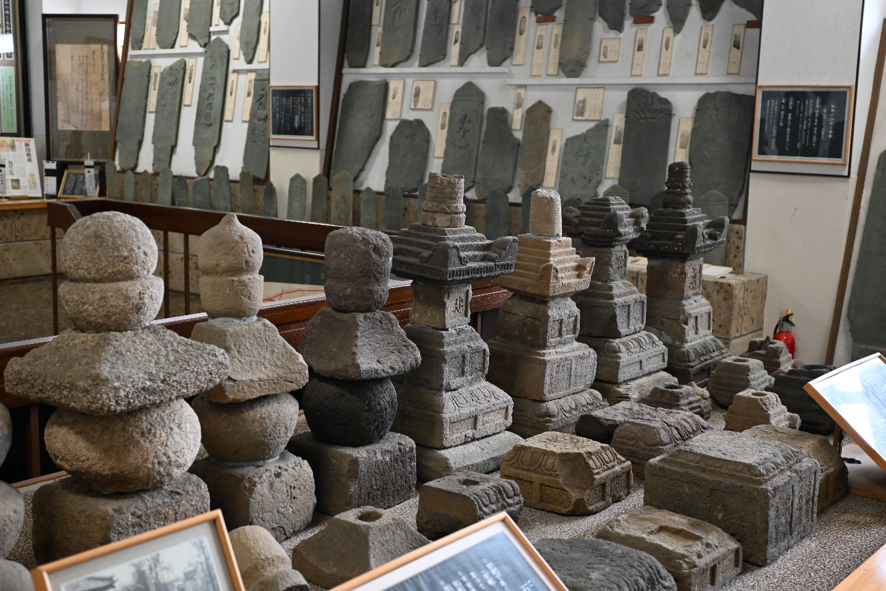
The adjacent Tokuzo-ji Stone Monument Preservation Hall displays an additional 150 stone monuments, which is truly impressive.

In Higashimurayama City, there is the ancient temple Shofuku-ji, founded by the Hojo clan (either Tokiyori or Tokimune), which houses the Jizo-do, the only wooden building in Tokyo designated as a National Treasure. Based on the ink inscription on the building, it is thought to have been built in 1407, but its size and style are similar to the Shariden (reliquary hall) of Engaku-ji Temple (also a National Treasure), and it is estimated that the Shariden was also built around the same time. The Shariden itself was originally the Buddha hall of Taihei-ji Temple, which was abandoned during the Sengoku period, and it is truly a blessing that this beautiful Zen Buddhist style Buddha hall has survived the turbulent times and been designated a National Treasure, preserving it to this day.

The temple gate dates back to the Genroku period, but its combination with the Jizo Hall is beautiful. It's a hidden gem to find a Buddhist temple of Kamakura quality right here in Higashimurayama, without having to go all the way to Kamakura.

Since I had come all this way, I decided to pay my respects at Ken Shimura's grave in the gravestone area of the Amida Hall at Baiganji Temple. There were many Shimura family gravestones lined up, and it took me a while to find his, but it was clear that the Shimura family had been a prominent family and landowners in this area since at least the Edo period.

In this town along the old highway, where traces of ancient, medieval, and modern times overlap, there seem to be many historical remnants yet to be seen. Let's hum the Higashimurayama Ondo while having a nightcap and remember Ken Shimura. Rest in peace.


Comments